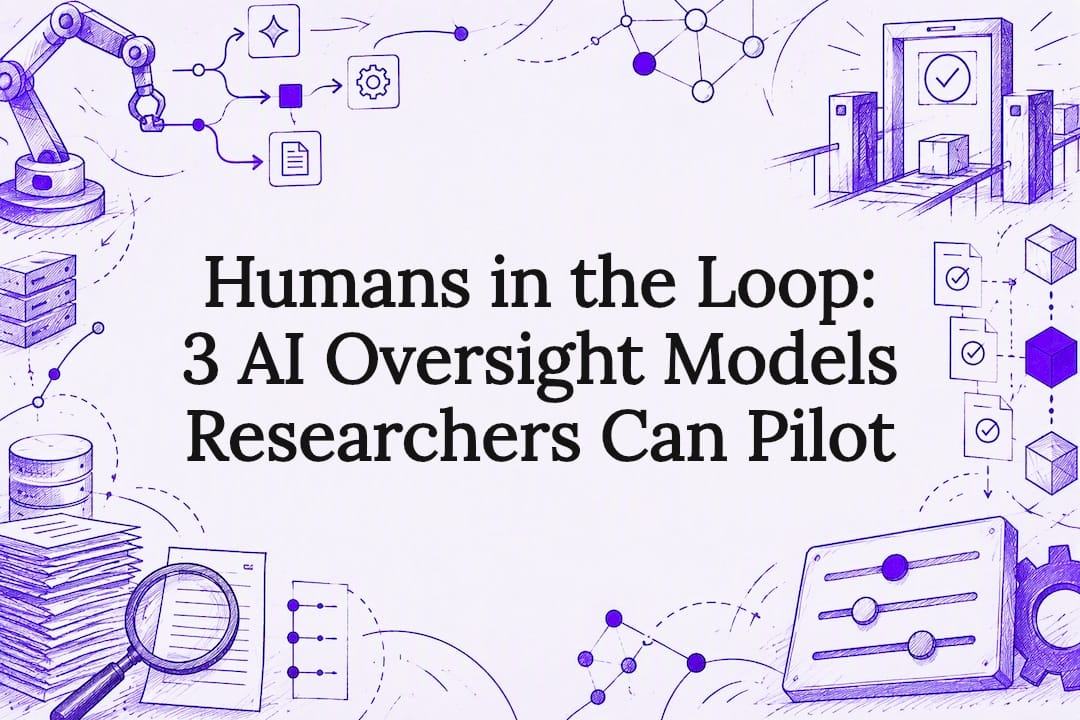
Human-in-the-loop (HITL) means a person actively participates in an AI workflow, supplying training data, evaluating outputs, or approving actions before they take effect. You need it whenever a decision is high-consequence, the input is ambiguous or unfamiliar to the model, or a policy requires sign-off before the system acts. The strongest implementations rely on selective escalation, clear review payloads, and audit logs rather than blanket human review of everything.
TL;DR:
- Reserve preapproval for consequential or irreversible actions; route low risk, reversible steps automatically, using confidence, unfamiliar inputs, and policy risk to trigger escalation.
- Give reviewers the proposed action, exact parameters, supporting evidence, policy reason, and potential downside, plus authority to edit, halt, or escalate.
- Set response deadlines and fallback behavior, prioritize urgent reviews, restrict reviewer data access, and log each decision with identity, timestamp, and outcome for audits.
- Measure escalation precision and recall, overrides, correction rates, review time, and reviewer agreement to assess whether human oversight catches errors effectively.
- Experimental participants became more willing to delegate when they could monitor algorithms, yet that oversight did not reliably improve final decision accuracy.
Table of Contents
- Taxonomy: human-in-the-loop, on-the-loop, and in-command
- Where humans sit across the AI lifecycle
- Designing escalation triggers, review payloads, and fallbacks
- How do you measure whether oversight is working?
- Training, interface design, and the governance layer
- Where HITL shows up in practice
- What the recent research actually shows
- What I’ve learned piloting these systems
- Getting help designing and deploying HITL workflows
- FAQ
- Sources
Taxonomy: human-in-the-loop, on-the-loop, and in-command
Before building anything, it helps to separate three terms that get used interchangeably but describe different relationships between people and automated systems.
- Human-in-the-loop means a person must act before the system proceeds: approving, editing, or rejecting an output before it becomes real.
- Human-on-the-loop means a person monitors the system as it runs and can intervene, but the system acts without waiting for approval.
- Human-in-command means a person retains ultimate authority over whether the system operates at all, including the power to shut it down regardless of its confidence or output.
These distinctions matter because they change what you measure and who is accountable when something fails. A loan-approval bot with a human-in-the-loop can’t disburse funds without sign-off. A fraud-monitoring system with a human-on-the-loop flags suspicious transactions while continuing to process the rest, and a reviewer watches the stream. A military or medical device operating under human-in-command policy might run autonomously most of the time but remains subject to a standing override.
Beyond that temporal axis, two others shape design decisions. Placement describes where in the AI lifecycle a person intervenes: during training and labeling, during evaluation and testing, or at runtime when the system is already live. Granularity describes the scope of each intervention, whether a reviewer approves an entire multi-step plan up front or checks each action as the system executes it. According to Stanford HAI’s definition of human-in-the-loop, common intervention points are training, evaluation, and runtime, and systems typically escalate when confidence drops below a threshold, when inputs look out of distribution, or when the policy consequence of acting autonomously is too high.
Getting this vocabulary right isn’t academic housekeeping. Teams that conflate human-on-the-loop monitoring with genuine human-in-the-loop approval tend to overstate how much control they actually have, and that gap shows up later as an incident that nobody caught in time.
Where humans sit across the AI lifecycle
Oversight shows up at different points in a system’s life, and each point carries its own cost, latency, and skill requirement.
- Training and labeling. Annotators generate the ground truth that supervised models learn from, and active learning routes the most uncertain or informative examples to human reviewers instead of asking them to label everything. Routine, low-ambiguity cases can rely on lighter labeling methods, while harder or higher-impact instances warrant richer feedback, a tradeoff described in research on active learning and feedback.
- Evaluation and red-teaming. Before deployment, people probe a model for bias, safety gaps, and adversarial weaknesses, and preference data collected for reinforcement learning from human feedback shapes how the model ranks its own outputs.
- Runtime escalation. Once live, a system routes specific actions, payments, account changes, external communications, or other irreversible steps, to a human for approval rather than executing them automatically.
- Feedback and retraining. Corrections made during runtime review don’t just fix a single case; they get logged and fed back into monitoring dashboards and future training runs, closing the loop between what reviewers catch and what the model learns next.
Each stage trades speed for judgment. Labeling is the cheapest per unit but shapes everything downstream. Runtime escalation is the most expensive per instance but catches the errors that matter most in the moment they’re about to cause harm.
Designing escalation triggers, review payloads, and fallbacks
A workflow that escalates everything collapses into a rubber-stamp exercise; one that escalates nothing defeats the point of having a human available at all, which is why enterprise IT must govern citizen development carefully as explained by Deny by Default Inventory. Good design starts with precise triggers.
- Escalation criteria typically combine confidence scores, out-of-distribution detection, policy or risk classifiers, and the inherent criticality of the action itself.
- Review payloads should give the reviewer everything needed to decide quickly: the proposed action, its exact parameters, the evidence or provenance behind it, the policy reason it was flagged, and an estimate of its downside if wrong. AWS’s overview of human-in-the-loop systems notes that external communications, payments, account changes, publication, deletion, and other irreversible changes are natural boundaries for mandatory approval, while reversible, low-risk steps can often stay automated.
- Reviewer controls need more than a binary approve or reject: edit, halt, and escalate-further options give a human room to correct a near-miss instead of just blocking it outright.
- Fallback behavior matters as much as the happy path. Define what happens if no reviewer responds within a latency budget, whether that means a conservative default action, a queue timeout that blocks further progress, or an automatic escalation to a second reviewer.
Operationally, this means setting a latency budget per action class, building queuing logic that doesn’t starve high-priority reviews behind routine ones, restricting data access so reviewers only see what they need, and logging every decision with reviewer identity, timestamp, and the resulting action for later audit.
Pro Tip: Build your review payload around the question “what would a reviewer need to see to decide in under thirty seconds,” then cut everything else out of the interface.
How do you measure whether oversight is working?
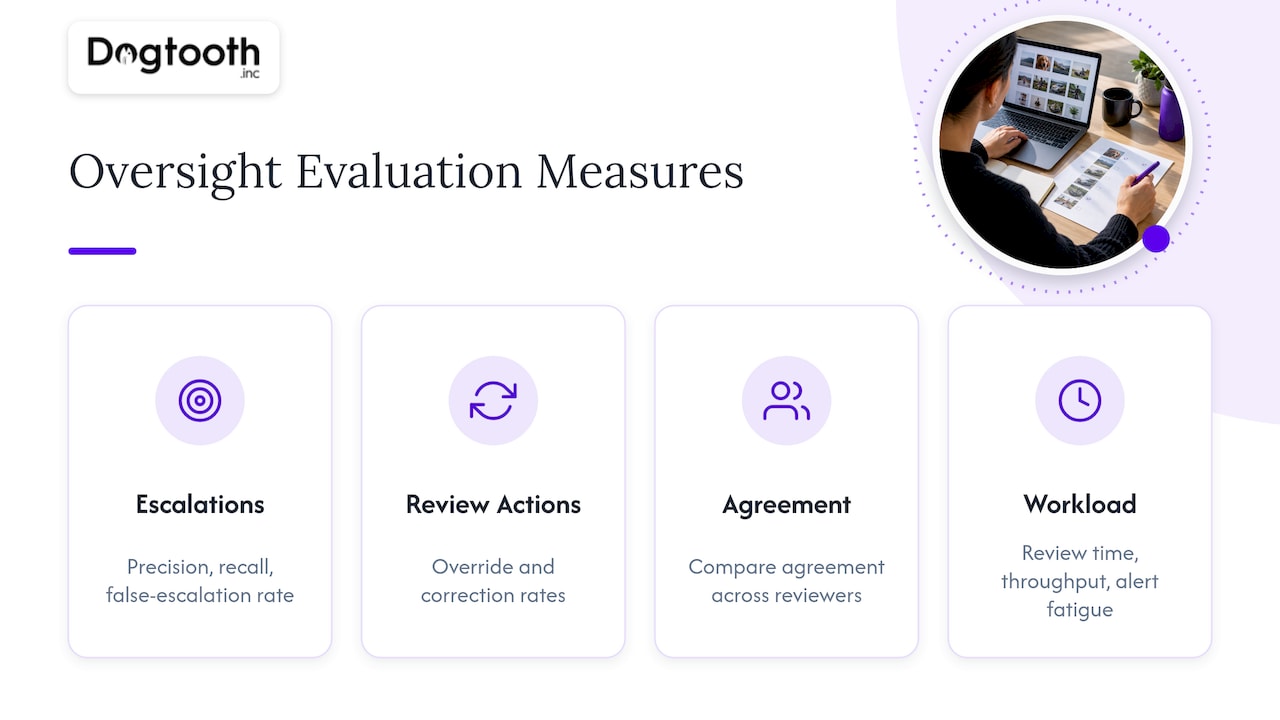
Adding a human checkpoint doesn’t automatically improve outcomes, so the evaluation has to go beyond counting how many actions got escalated. Operational research on oversight evaluation recommends tracking escalation precision and recall, the rate of false escalations, override and correction rates, reviewer agreement, and workload, rather than treating the mere presence of a human reviewer as evidence of safety.
One of the more striking findings is that experimental participants preferred delegating a prediction to an algorithm over an equally accurate human 66% of the time, and allowing monitoring and adjustment increased that delegation preference further. The same study found that participants given oversight capability were less likely to intervene on the recommendations that most needed correcting, which means the review step existed without doing the job it was meant to do.
Beyond accuracy metrics, operational health indicators matter just as much: time-to-review, reviewer throughput, and signs of alert fatigue such as declining intervention rates over a shift. Sampling a portion of approved actions for independent re-review, rather than trusting that approval equals correctness, is one of the few reliable ways to catch a reviewer who has started rubber-stamping.
Training, interface design, and the governance layer
A reviewer with no real authority or no way to see what matters isn’t providing oversight, just a procedural delay. ISO/IEC DIS 42105 guidance on human oversight frames this directly: supervisors need sufficient ability to monitor and control the system, and oversight is a socio-technical capability that depends on transparency, interface ergonomics, training, and governance, not just the presence of a person in the workflow.
Several practices make that capability real rather than nominal.
- Reviewer playbooks and calibration exercises keep judgment consistent across a team and across time, catching the drift that happens when standards slip gradually.
- Interface legibility surfaces the decision-critical moment clearly, so a reviewer recognizes when intervention actually matters instead of scanning a wall of routine approvals.
- Periodic audits of reviewer decisions, not just system outputs, catch automation bias before it becomes the norm.
- Clear authority specification in organizational policy defines what a reviewer can actually change, and prevents the common trap of inserting a human into a process without giving them real power to act on it.
That last point echoes a caution sometimes called the MABA-MABA trap (men-are-better-at, machines-are-better-at): assigning a person to a checkpoint without giving them the capability, time, or authority to meaningfully intervene produces the appearance of oversight without its substance. Legal scholarship on where humans get placed in automated loops makes a similar point: regulation that mandates “a human in the loop” without specifying role, authority, and support tends to produce reviewers set up to fail rather than genuine safeguards.
Where HITL shows up in practice
Human oversight patterns look different depending on the domain, but the underlying logic, escalate what’s ambiguous or consequential, stays consistent.
- Healthcare diagnostics route borderline imaging results or novel presentations to a specialist rather than letting a model’s confidence score stand alone.
- Content moderation escalates edge cases, policy-ambiguous posts, or appeals to trained reviewers while automated filters handle clear violations at volume.
- Fraud detection flags transactions that deviate from a user’s pattern for manual review instead of auto-blocking or auto-approving every borderline case.
- Conversational and LLM-powered agents increasingly need runtime escalation for any action with external consequences: sending an email, booking a resource, or completing a purchase.
That last category is where we’ve done the most direct work. Our AI booking system for three combat sports brands books sessions, charges cards, and sends invites across multiple brands from one system, with review boundaries built around the actions that actually carry financial and scheduling risk rather than every interaction the agent handles. We’ve applied similar privacy-aware controls in a Meta CAPI tracking deployment across more than fifteen ad accounts, where audit requirements around data handling shaped how reviewers access and act on sensitive information. Choosing between internal subject-matter experts and broader reviewer pools generally comes down to how much domain judgment a given escalation requires: a payment-approval flag needs less specialized expertise than a clinical or legal edge case.
What the recent research actually shows
The clearest finding from the PLOS ONE oversight experiment is a tension: giving people the ability to monitor and adjust an algorithm’s output increased their willingness to use the algorithm at all, but it didn’t reliably improve the accuracy of the final decisions, and it sometimes masked the cases that most needed correction.
Comparative work on oversight strategies for computer-use and LLM-powered agents reaches a related conclusion from a different angle. Research comparing oversight strategies for agents found no single approach, plan-level approval versus step-level monitoring, synchronous versus asynchronous review, was uniformly best. Plan-based review reduced problematic actions without always improving a reviewer’s ability to intervene successfully at runtime. The paper’s central claim is that the bottleneck isn’t review volume, it’s making risky moments legible enough that a human actually recognizes them as worth stopping for.
Open questions that remain active: how oversight scales as agent autonomy increases, how reviewer judgment drifts over long shifts, and how to design interfaces that reliably surface the moment a decision turns consequential.
What I’ve learned piloting these systems
Start narrower than feels necessary: pick one action class, define its escalation boundary precisely, and measure override rate and time-to-review before expanding scope. Recruit reviewers who understand the domain, not just the interface, and expect to recalibrate escalation thresholds within the first few weeks as false positives surface. The two failure modes I see most often are escalating too much, which trains reviewers to stop reading, and escalating too little, which leaves the riskiest actions unguarded. Treat the first pilot as a measurement exercise before treating it as a control.
— Chase Weir
Getting help designing and deploying HITL workflows
Building a review payload, escalation trigger, and audit log that actually hold up in production takes more than a weekend project, and we approach it with a human approval step before sending. That’s the same pattern we build for clients.

Our AI agents and automation work handles exactly this kind of integration, connecting a model to real booking, payment, and communication systems with the escalation boundaries and logging a production workflow needs. If you want a concrete reference point, our AI booking system for three combat sports brands shows how we handled payments, scheduling, and invites across multiple brands inside one reviewed workflow.
- We design the escalation criteria and review payloads specific to your action set.
- We build the integration layer connecting your model to the systems it needs to act on.
- We stay on after launch to tune thresholds as real usage reveals edge cases.
If you’re scoping a pilot, reach out through our site to talk through what a narrow first deployment could look like for your workflow.
FAQ
What does human-in-the-loop mean in AI?
Human-in-the-loop means a person actively participates in an AI system’s workflow, providing training labels, evaluating outputs, or approving actions before they take effect. According to Stanford HAI, the main intervention points are training, evaluation, and runtime, with escalation typically triggered by low confidence, out-of-distribution inputs, or high-consequence actions.
What is the difference between human-in-the-loop and human-on-the-loop?
Human-in-the-loop requires a person to approve an action before it happens, while human-on-the-loop lets the system act autonomously while a person monitors it and can intervene if something goes wrong. The first prioritizes prevention; the second prioritizes speed with a safety net attached.
What is human-in-the-loop for AI agents?
For AI agents that take multi-step actions, human-in-the-loop usually means routing specific steps, like payments, external communications, or irreversible changes, to a person for approval while lower-risk steps proceed automatically. Research comparing oversight strategies for computer-use agents found that no single strategy works best across contexts, and that making risky moments recognizable to the reviewer matters more than reviewing a high volume of actions.
What is human-on-the-loop?
Human-on-the-loop describes a supervisory relationship where a person monitors a running AI system and retains the ability to intervene, but the system doesn’t wait for explicit approval before acting. It suits high-throughput situations where full pre-approval would create unacceptable latency, provided the monitoring interface makes the moments that need intervention genuinely visible.
How do teams measure whether human oversight is actually effective?
Effective measurement relies on operational metrics such as escalation precision and recall, override and correction rates, time-to-review, and reviewer agreement, rather than simply counting how often a human was involved. One experimental study found that giving reviewers monitoring and adjustment ability increased their willingness to delegate to an algorithm without reliably improving the accuracy of the final decisions.
Sources
- What is Human in the Loop? — Stanford HAI
- Putting a human in the loop: Increasing uptake, but decreasing accuracy of automated decision-making — PLOS ONE (2024)
- ISO/IEC DIS 42105: Guidance for human oversight of AI systems