TL;DR
- The Shopify account opened on March 17, 2026. On launch day, May 10, the store took 325 orders worth $35,161.
- Total sales passed $1M on September 17, 2026, 130 days after launch. By October 20 the store had taken 12,726 orders from 4,820 customers.
- 88% of orders included a subscription. By September, three out of every four orders were automatic renewals.
- Dogtooth built and ran the infrastructure. The brand ran all of the marketing. We spell out the split below.
At a glance
- Client
- A founder-led supplement brand, new in 2026. We keep the name private.
- Platform
- Shopify
- Dogtooth's scope
- Store setup, design and build of every page, product-page and email copy, subscriptions, upsells, affiliate tracking, email automation and the support stack
- The brand's scope
- The products, manufacturing and fulfillment, and all promotion and traffic
- Timeline
- Build began March 17, 2026 · launched May 10, 2026 · $1M in total sales on September 17, 2026
- Team
- Seven people at Dogtooth across design, development, copy and operations
The brief: a ready audience and no store
The founder had a large, loyal audience in natural health and a first formula going into production. There was no store, no email platform, no subscription billing and no way to track or pay affiliate partners. The brand wanted to launch in April 2026, with more products to follow.
Four requirements shaped the build:
- Subscriptions on day one, with monthly and quarterly plans.
- A checkout that could absorb a launch-day rush from the founder's list.
- Affiliate partners tracked from their first referral, with commission rules the brand could change on its own.
- Product pages that stay inside supplement advertising rules: no disease claims, and every structure-function statement carrying the FDA disclaimer.
Who did what
The brand sent every visitor. Dogtooth built everything those visitors used to buy, from the first product page to the renewal charge three months later.
What Dogtooth built and ran
- Shopify store setup, theme, custom domain and checkout with Shop Pay
- Design and build of 16 pages: 4 product pages, a homepage, 2 long-form sales letters, 2 partner landing pages, 4 brand and policy pages, a retail store locator and 2 webinar pages
- Copy for the product pages, the homepage, the store's automated emails and a 31-email webinar sequence
- Subscription billing on Shopify, later moved to Seal
- Single and 3-bottle bundles, post-purchase upsells in Zipify and discount rules
- Affiliate tracking and commission rules in Everflow
- An email platform built from zero in ActiveCampaign, with abandoned cart, welcome and review-request automations
- Support desk with an AI agent (Gorgias), product reviews (Judge.me) and session recordings (Microsoft Clarity)
- Amazon listings for all four products
What the brand did
- Formulated, manufactured and shipped the products
- All promotion: the founder's newsletter and email list, affiliate partners, partner webinars, talks and interviews
- Wrote the two long-form sales letters and the stock-out notices, which we designed and built
- Staffed customer service
The build: 54 days from an empty account to launch day
Shopify account created. Store setup, payments and the fulfillment connection begin.
Product images prepared for the store.
The brand approves the sales page design.
Store restyled to the brand's final colors.
Affiliate program live in Everflow, with the first partners added.
Custom domain connected and the store moved to the brand's live Shopify account.
End-to-end QA of the product page, subscription plans, discounts and tracking.
First customer order.
Launch day: 325 orders.
The original target was April 12. The brand moved the launch date twice, and we used the extra weeks to rework pricing twice and test the checkout end to end.
Launch day: 325 orders in 24 hours
On May 10, 2026, the store took 325 orders worth $35,161. The first week brought 880 orders and $95,692. The first 30 days brought 2,174 orders and $243,675.
The store's first automatic renewals ran on June 7, 2026, a month after the first orders. Nobody had to sell those customers a second time.
Four products in ten weeks
The catalog grew from one product to four between May and mid-July. Each launch shipped as the same package: a product page, single and 3-bottle options, monthly and quarterly subscription plans, an upsell placement and an affiliate offer. One team held all of it, so each new product reused the same setup instead of starting over.
| Product | First order | Share of product sales |
|---|---|---|
| Flagship formula | May 7, 2026 | 53% |
| Second formula | June 2, 2026 | 27% |
| Men's multivitamin | July 10, 2026 | 7% |
| Women's multivitamin | July 16, 2026 | 13% |
Before the multivitamin pages went live, we traced every clinical figure in the product brief back to its source study. Twelve figures had no study we could find, so we replaced them with cited numbers before anything published.
Subscriptions carried the growth
Every product launched with a subscribe-and-save option on monthly and quarterly plans. 88% of all orders included a subscription item.
Renewals produced 5,956 orders and $463,416 through October 20, 38% of the store's order revenue, without anyone going back through checkout. By September, 75% of orders were renewals. 59% of the store's 4,820 customers have ordered more than once.
The September drop in checkout orders lines up with the flagship formula selling out from September 2 to October 3. Renewal volume held steady through the same weeks.
Running the store after launch
We kept running the store after launch. The work since May includes:
- Moving about 3,000 live subscription contracts from Shopify's subscription app to Seal in September. When Seal's import tool kept looping, we rebuilt the contracts by hand.
- Tracing 520 subscriptions that had quietly stopped renewing, worth about $37,800 a month, to canceled contracts, and giving the brand the list.
- Building sold-out states and the subscriber emails when the two best-sellers ran out of stock.
- Fixing a sales tax setting, a Safari script error on the product pages and an affiliate rule that rejected valid sales as duplicates.
- Launching a webinar registration funnel and writing its 31-email sequence.
- Getting all four products listed and buyable on Amazon.
Results
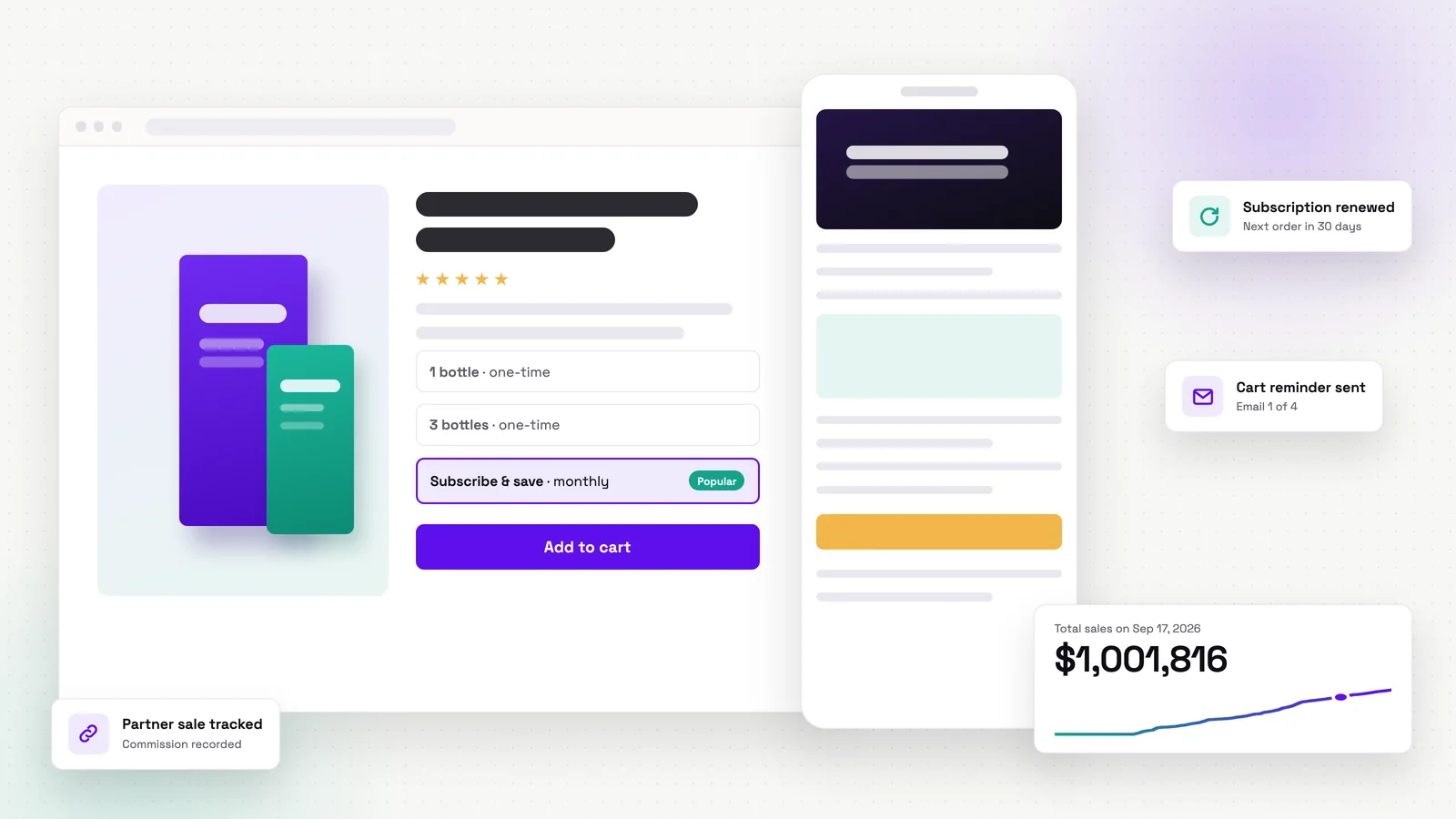
- $1,001,816 in total sales by September 17, 2026, six months after the Shopify account opened and 130 days after launch. Net sales, before shipping and tax, passed $1M on September 25.
- $1,195,025 in total sales by October 20, 2026.
- 12,726 orders from 4,820 customers, with an average order of $96.
- 325 orders on launch day and $243,675 in the first 30 days.
- Four products live within ten weeks of the first order.
- 38% of order revenue from automatic renewals, rising to 75% of monthly orders by September.
| Month | Total sales | Orders | Renewal share of orders |
|---|---|---|---|
| May 2026 | $201,097 | 1,788 | 0% |
| June 2026 | $207,383 | 2,315 | 31% |
| July 2026 | $190,162 | 2,195 | 55% |
| August 2026 | $317,233 | 3,185 | 52% |
| September 2026 | $169,550 | 2,138 | 75% |
| October 1–20, 2026 | $109,600 | 1,105 | 70% |
How we measured: total sales come from Shopify Analytics (gross sales minus discounts and returns, plus shipping and tax). Order counts come from the store's full order export and exclude 62 internal test orders and 20 canceled orders. Launch-day, launch-week and 30-day figures are order totals in US Eastern time. Data pulled October 20, 2026.
What we'd tell a founder launching to an audience they already have
Launch with subscriptions on
Renewals made up 38% of this store's revenue. Every launch-week subscriber who stayed paid again each month or quarter, and no one had to sell them twice.
Keep the pages, email and billing with one team
When the flagship sold out on September 2, we put the sold-out state on its pages that day and had the subscriber email built the next morning. That speed came from one team holding the theme, the email platform and the subscription app.
Plan for change after launch
The March plan had one product and Shopify's built-in subscriptions. By September the store had four products, a different subscription app, Amazon listings and a webinar funnel. Budget for a team that stays on.
Check every claim before it ships
Supplement copy carries legal risk. Twelve unverifiable figures in one product brief would have gone live without a source check.
FAQ
How long did it take to build the Shopify store?
The Shopify account was created on March 17, 2026. The first customer order came on May 7, and the first full launch day was May 10, 2026, 54 days after the account opened. The original target was April 12; the brand moved the date twice.
Did Dogtooth run the marketing or ads?
No. The brand handled all promotion, mainly to its founder's existing audience and through affiliate partners. Dogtooth built and ran the store, pages, copy, emails, subscriptions and tracking that turned that audience into orders.
What tech stack did the store run on?
Shopify with Shop Pay for checkout, Shopify's subscription app and then Seal for subscriptions, Zipify for post-purchase upsells, Everflow for affiliate tracking, ActiveCampaign for email, Gorgias for support, Judge.me for reviews and Microsoft Clarity for session recordings.
How much of the revenue came from subscriptions?
88% of orders included a subscription item. Automatic renewals alone produced 5,956 orders and $463,416, about 38% of order revenue through October 20, 2026. By September, 75% of monthly orders were renewals.
Did Dogtooth write all of the copy?
We wrote the product pages, the homepage, the automated emails and the webinar email sequence. The two long-form sales letters came from the brand's copywriter, and the stock-out notices came from the brand's team; we designed and built both.
Why isn't the brand named?
We keep client names private unless a client asks to be featured. Every number on this page comes from the store's own Shopify data.
Can Dogtooth build a store like this for my brand?
If you have a product and a way to reach buyers, yes. Book a call and we'll tell you fast whether we're a fit.