An AI booking agent can autonomously handle routine reservations, availability checks, confirmations and simple changes across voice, chat and web when it has live access to your calendar, CRM and payment tools. Industry research on agentic AI, human-in-the-loop practice and our own multi-brand case study point the same way. You get faster confirmations, fewer no-shows and less manual work.
TL;DR:
- Before launch, confirm that your calendar supports live availability and writes, your CRM accepts updates, and payment and refund rules are documented.
- For cancellations, verify the policy, apply the correct fee or refund, release the slot, and offer it to the waitlist in one workflow.
- The agent should route clinical questions, unclear payment issues, upset customers, and policy exceptions to staff with the transcript and booking state attached.
- Track conversion, confirmation time, errors, escalations, and staff hours against a baseline weekly; expand beyond one booking type and channel only when results hold steady.
- Assign an owner to review transcripts, audit logs, and edge cases after launch; custom integrations and ongoing supervision drive much of the cost.
Table of Contents
- What can an AI booking agent actually do?
- Where do AI booking agents fit by industry?
- Which channels and integrations does an agent need?
- How do AI booking agents work in production?
- What does a realistic implementation roadmap look like?
- How do you measure whether an AI booking agent is working?
- What does a real multi-brand booking implementation look like?
- Start narrow, instrument everything, keep a senior eye on it
- How we can help you build and run an AI booking agent
- FAQ
- Sources
What can an AI booking agent actually do?
The useful test is whether the agent can act, not just talk. A chatbot that answers “what time are you open?” is a help desk. An agent that finds a slot, writes it to your calendar and sends the confirmation is an operator. The difference is authorization, and it is the core of what reliable systems get right.
Here are the actions a capable agent should handle:
- Book a new reservation or appointment against live availability.
- Reschedule and cancel existing bookings, applying your change and refund rules.
- Hold a slot for a short window while a customer finishes payment or checks with a partner.
- Waitlist customers when a time is full, and offer openings the moment they appear.
- Change seats, rooms or party size on an existing reservation without starting over.
- Issue confirmations and reminders by text, e-mail or voice.
On the customer side, people can speak naturally on a call, type into a chat window, or use a web widget embedded on your site. Each channel should feed the same booking logic, so a customer who starts in chat and finishes by phone sees one consistent record.
Behind the scenes, the operational features matter more than the demo. Look for audit logs of every action, two-way sync with your calendar and CRM, webhook and API endpoints so other systems can react to bookings, links to payment or point-of-sale tools, and reporting you can actually read.
Before you buy or build, check the prerequisites. Does your calendar expose real-time availability through an API? Can your CRM accept writes, not just reads? Are payment and refund rules written down clearly enough for an agent to follow? An agent is only as capable as the systems it can touch and the policies it can read. If any of those three is missing, fix it first, because a polished conversation layer on top of a blind system just produces confident mistakes.
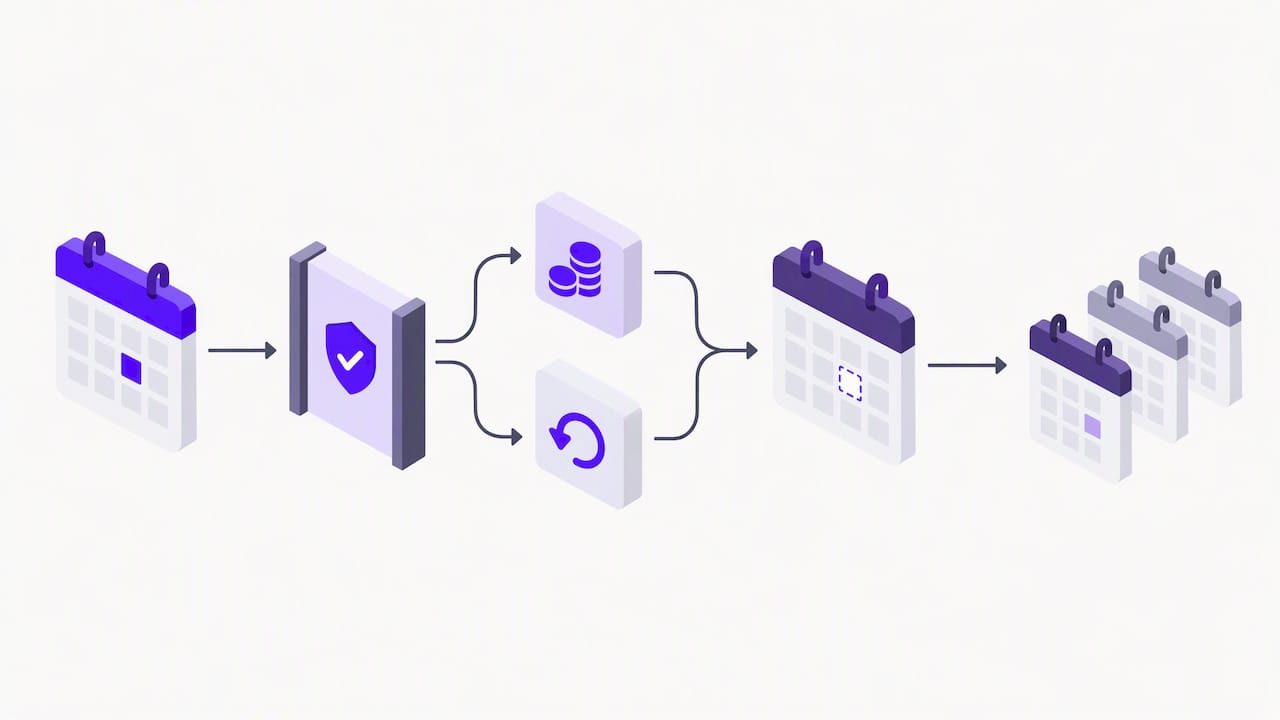
Cancellations deserve special attention. A good agent does not simply delete a booking. It checks the cancellation window, applies the right fee or refund, releases the slot, and offers that slot to the waitlist in one pass. That chain of small decisions is where manual teams lose the most time, and where automation pays back first.
Where do AI booking agents fit by industry?
Booking looks different in every business, so match the agent’s strengths to the actual problem you have.
- Events and ticketing: Agents allocate seats, handle VIP upgrades, manage waitlists and send confirmations across channels. Peak demand arrives in bursts, and an agent does not get tired during an on-sale rush.
- Hospitality: Group bookings are the hard part. An agent can coordinate room blocks, check multi-room availability across your property management or central reservation system, and collect details from several guests in one thread.
- Healthcare: Agents handle intake scheduling and send automated reminders to reduce no-shows. They must also recognize when a request sounds clinical and escalate to staff immediately instead of guessing.
- Restaurants: Table assignment, waitlist management, deposits and point-of-sale-linked refunds are all routine and rule-based, which suits automation well.
- Retail and services: Class sign-ups, session bookings and multi-brand scheduling benefit from one consolidated customer record across every brand you run.
The pattern across these industries is the same. Work that is repetitive, rule-driven and tied to a system of record is a strong candidate. Work that needs judgment, empathy or clinical expertise should route to a person, with the agent preparing context first.
McKinsey’s analysis of agentic AI in travel makes a related point: the most transformative potential sits in vertical, functional use cases built into operational workflows, not in generic conversation. That matches what we see. A narrow agent that does one booking job inside your real systems beats a broad assistant that can only chat.
Phocuswright’s 2025 trends research adds a demand-side signal. It notes growing traveler interest in reserving trip components through generative chat and anticipates autonomous agents shopping and booking on a traveler’s behalf. It also stresses that adoption depends on trust and on integration with inventory systems. For a business owner, the takeaway is practical: customers will increasingly arrive through chat-style interfaces, and your booking logic needs to be reachable from them.
Industry fit also shapes your risk tolerance. A restaurant can let an agent confirm a table with minimal oversight. A clinic should keep a human close to anything resembling symptoms or urgency. Set the autonomy level per use case instead of applying one setting everywhere.
Which channels and integrations does an agent need?
An agent that cannot see your live data will invent answers, so integrations are the real product. Each touchpoint solves a specific failure.
- Calendar access in real time: This prevents double bookings. If the agent works from a cached or delayed copy, two customers can claim the same slot. Require live reads and atomic writes, so a slot is claimed once.
- Telephony and voice: Voice booking needs a phone number, call routing, speech recognition and a way to hand a live call to a person. It differs from chat in important ways. Callers interrupt, mishear dates and give information out of order, so the agent must confirm key details aloud before committing. Chat and web flows can show a slot picker, which removes much of that ambiguity.
- CRM two-way sync: The agent should read who the customer is and write back what happened. That keeps records consistent and lets follow-up messages, such as reminders and post-visit notes, reflect the real booking history.
- Payments and point of sale: Deposits, payment captures and refunds must connect to the booking, not live in a separate process. If a cancellation releases a slot but never triggers the refund, you have created a support ticket and an unhappy customer.
- Monitoring and observability: Production agents need alerts for failed writes, unusual cancellation spikes, repeated escalations and slow responses. Log every tool call so you can trace what happened when something goes wrong.
If voice is your priority, it helps to see how others describe the front-desk experience. This write-up on an AI business receptionist covers call handling and bilingual front-desk automation. For local service businesses, Picshaw’s AI receptionist shows how a receptionist-style agent covers missed and after-hours calls.
Plan for handoff as an integration too. When the agent passes a conversation to a person, that person needs the transcript and the booking state in whatever tool your team already uses. A handoff that forces staff to ask the customer to repeat everything undoes the value of automation.
How do AI booking agents work in production?
Reliable agents follow a predictable sequence, and they run inside limits you define.
- Intent detection: The agent works out what the customer wants: a new booking, a change, a cancellation or a question.
- Availability check: It queries live inventory or calendar data for matching options.
- Authorization: It confirms the action is allowed, including the customer’s identity, the policy that applies and any amount to charge.
- Write-back: It commits the booking to your system of record and updates the CRM.
- Confirmation: It sends the customer a confirmation and schedules reminders.
Guardrails wrap every step. Permission scopes limit what the agent can touch, so a booking agent cannot edit pricing or delete customer records. Refusal rules stop unsafe shortcuts, such as overriding a full schedule because a customer insists. Policy enforcement keeps refund windows and deposit rules consistent.
Human-in-the-loop design decides when a person steps in. Escalate when the request falls outside policy, when the customer is upset, when money or health is involved in an unclear way, or when the agent’s confidence is low. Voiceflow’s practitioner guidance describes the same pattern: agents work inside strict guardrails, hand off edge cases with the full transcript and prepared context, and refuse unsafe shortcuts. It frames this as what separates reliable implementations from failed pilots. After the person resolves the case, the work should return to the agent so it can send the confirmation and update records.
Auditability ties it together. Keep transcripts, transaction logs and replayable context so you can resolve disputes and understand mistakes. McKinsey’s travel analysis reaches the same conclusion from a strategy angle: agents must be integrated as authorized actors inside operational workflows to move past pilot mode, which a purely conversational bot cannot do.
Pro Tip: Give every escalation a reason code, such as policy exception, payment issue or upset customer. Reviewing those codes can show you which rule to automate next.
For deeper reading on governance, see our guide to AI agent safety and runtime controls and our breakdown of human-in-the-loop oversight models.
What does a realistic implementation roadmap look like?
Start smaller than you think you should. A narrow pilot teaches you more than a broad launch, and it limits the blast radius of early mistakes.
- Pick one booking type on one channel. For example, new appointments through web chat, or table reservations by phone. Write down the success metrics before you build anything.
- Connect the calendar first. Live availability is the foundation. Get reads and writes working and tested against real scenarios.
- Add the CRM. Sync customer records both ways so confirmations and follow-ups reflect reality.
- Add payments or deposits if your booking requires them, including refund logic.
- Connect industry systems such as ticketing or property management, then wire up monitoring and alerts.
- Expand deliberately. Add channels, booking types or brands only after the pilot metrics hold steady.
Timelines vary with your systems. A pilot against a modern calendar with a clean API moves faster than one that needs a legacy system wrapped in new endpoints. Phased rollout across additional channels and brands follows after the pilot proves out. Messy data, unclear policies and multiple systems of record are what stretch the schedule, so cleaning those up early shortens it.
On cost, expect the main drivers to be custom integrations, telephony, payment connections and ongoing supervision. Integration work is usually the largest piece because every system has quirks. Budget separately for safety, logging and tuning after launch. Agents improve through iteration, and teams that treat launch as the finish line tend to see quality drift. Plan for a retainer or an internal owner who reviews transcripts, adjusts policies and handles new edge cases each month.
How do you measure whether an AI booking agent is working?
Pick a small set of numbers, track them weekly and compare against your pre-agent baseline.
- Autonomous resolution rate: the share of bookings the agent completes without a handoff. This is your headline number.
- Booking conversion and time to confirmation: how many inquiries become bookings, and how quickly customers get a confirmed answer.
- No-show rate: compare reminder-enabled bookings against your baseline to see whether reminders are working.
- Error and escalation rates: wrong bookings, escalations per volume, and refund or dispute frequency.
- Operational savings: staff hours returned and first-contact resolution.
Industry signal: McKinsey’s analysis says agentic AI must act as an authorized actor inside operational workflows to move beyond pilot mode, so track completed actions, not just conversations handled.
Review escalation reasons alongside the numbers. A rising handoff rate on one booking type usually points to a missing rule or an integration gap, not a failing agent.
What does a real multi-brand booking implementation look like?
We built an AI booking system, and you can read the details in our full case study. It is a good example of the integration-first approach described above.
-
Scope: An agent books sessions, charges cards and sends calendar invites across multiple brands.
-
Architecture: The agent books sessions, charges cards and sends calendar invites across multiple brands.
-
Why it matters: Multi-brand setups multiply edge cases.
Start narrow, instrument everything, keep a senior eye on it
My view is simple: the agents that survive are the ones whose owners treated governance as part of the product. Start with one booking type. Log every action. Put a senior person on the first months of transcripts, because that is where you find the rules nobody wrote down.
Keep a short checklist: defined permission scopes, written escalation rules, complete audit logs and a regular review cadence. Then keep tuning. Deployment is the start of the work, not the end of it. Teams that stop watching an agent after launch usually discover the problems from angry customers instead of dashboards.
— Chase Weir
How we can help you build and run an AI booking agent
We build agents that book, charge and confirm inside real workflows, and we run our own operation the same way. Our case study shows the approach in production. If you want a booking agent with proper guardrails, here is what we bring:
- AI agents and automation designed around your booking rules
- Integrations and APIs for calendars, CRMs and payments
- Platform builds and migrations when your current systems cannot support an agent
- Ongoing support after launch, so the agent keeps improving
Review the booking case study, then book a call to scope a pilot. You can also see everything we build on our services page.
FAQ
What is an AI booking agent?
An AI booking agent is software that completes reservations and appointments for customers through chat, voice or web. It checks live availability, writes bookings to your calendar or CRM and sends confirmations. Unlike a basic chatbot, it takes authorized actions inside your systems.
What are the main types of AI agents?
Common categories include simple reflex agents, model-based agents, goal-based agents, utility-based agents and learning agents. Definitions vary by textbook and vendor, so treat any fixed count as a convention. Booking agents are typically goal-based: they work toward a confirmed reservation within set rules.
How do you keep an AI booking agent safe?
Limit its permissions, define what it must refuse and escalate edge cases to a person with the full transcript. Practitioner guidance from Voiceflow describes this guardrail and handoff pattern. Keep audit logs so every action can be reviewed later.
Where should you start with an AI booking agent?
Start with one booking type on one channel, such as new appointments through web chat. Connect your calendar first, define success metrics and expand only after results hold steady. A narrow pilot limits risk and shows you which policies need writing down.
Sources
- The future of agentic AI in travel and hospitality | McKinsey
- Phocuswright’s Travel Innovation and Technology Trends 2025: Phocuswright
- AI appointment scheduling & booking agents | Voiceflow