
API-first architecture means you design the API as the primary interface of a service, and agree on it with the people who will use it, before anyone writes the implementation. The API contract, usually an OpenAPI document, becomes the first deliverable. Servers, clients, tests and documentation all follow from it. Teams that work this way can build in parallel, change direction cheaply, and connect new channels without rebuilding the core.
This guide covers how the workflow runs, how it differs from code-first development, what it demands of microservices, how to run an API gateway well, and how to adopt it without drowning in inconsistent endpoints.
TL;DR
- API-first means the written contract (OpenAPI or AsyncAPI) is agreed on before implementation, so frontend, backend, QA and partners can work at the same time.
- Code-first treats the API as a by-product of the application. API-first treats it as a product with consumers, versions and owners.
- In microservices, each service owns its data, publishes a versioned contract, and prefers additive changes. A gateway centralizes authentication, rate limiting and routing.
- The real costs are upfront planning, governance and keeping specs, mocks and code in sync. Automated linting and breaking-change checks in CI handle most of it.
Table of Contents
- What API-first architecture actually means
- How the API-first workflow runs
- API-first vs. code-first
- Designing APIs for microservices
- API gateway best practices
- Adopting API-first across an organization
- Tradeoffs to plan for
- Our perspective
- Build on a contract with Dogtooth
- FAQ
- Sources
What API-first architecture actually means
In an API-first approach, APIs come at the start of development and are treated as building blocks. Postman describes it as designing or building the API with the business before writing code, so the application can connect with internal and external applications and services. The design-first variant produces a contract that people and machines can both read.
Three ideas sit inside that definition:
- The contract is the source of truth. At Zalando, API-first means designing the API outside of code with the OpenAPI Specification and treating the definition as part of the agreement between provider and consumers. Early feedback comes from a lightweight review involving peers and consumers.
- Consumers shape the design. Product owners, frontend developers, partner engineers and QA all comment on a readable spec before it is expensive to change.
- The API is a product. It has a lifecycle, documentation, versioning rules and someone accountable for it.
The business case is reuse and speed. Organizations adopt the approach to build reusable features quickly, deploy them across devices and channels, and adapt to new demands and compliance requirements. The same source credits API-first design and microservice strategies with the scalability that companies such as Netflix, Amazon, Etsy and Uber achieved.
How the API-first workflow runs
The VMware Tanzu team lays out seven high-level steps, starting from an OpenAPI 3.0.x specification. In practice they look like this:
- Gather requirements. Map the customer journeys and the data each one needs. McKinsey advises that deciding which APIs to build first starts with the most important customer journeys and the complementary APIs needed to unlock data, cloud and core systems.
- Write the specification. Describe operations, inputs, outputs, error states and auth in OpenAPI.
- Review it with stakeholders. Because the spec is readable, feedback arrives early. Tanzu notes that changing a spec takes minutes, not hours or days.
- Version and share it. Store the spec in the repository next to the service so other teams can find it.
- Mock and generate. Once the spec is good enough, you can generate server skeletons and client SDKs in many languages, and stand up mock servers so consumers can start building.
- Implement business logic behind the contract.
- Test, deploy and monitor, then iterate while keeping backward compatibility.
What a modern contract-first pipeline contains
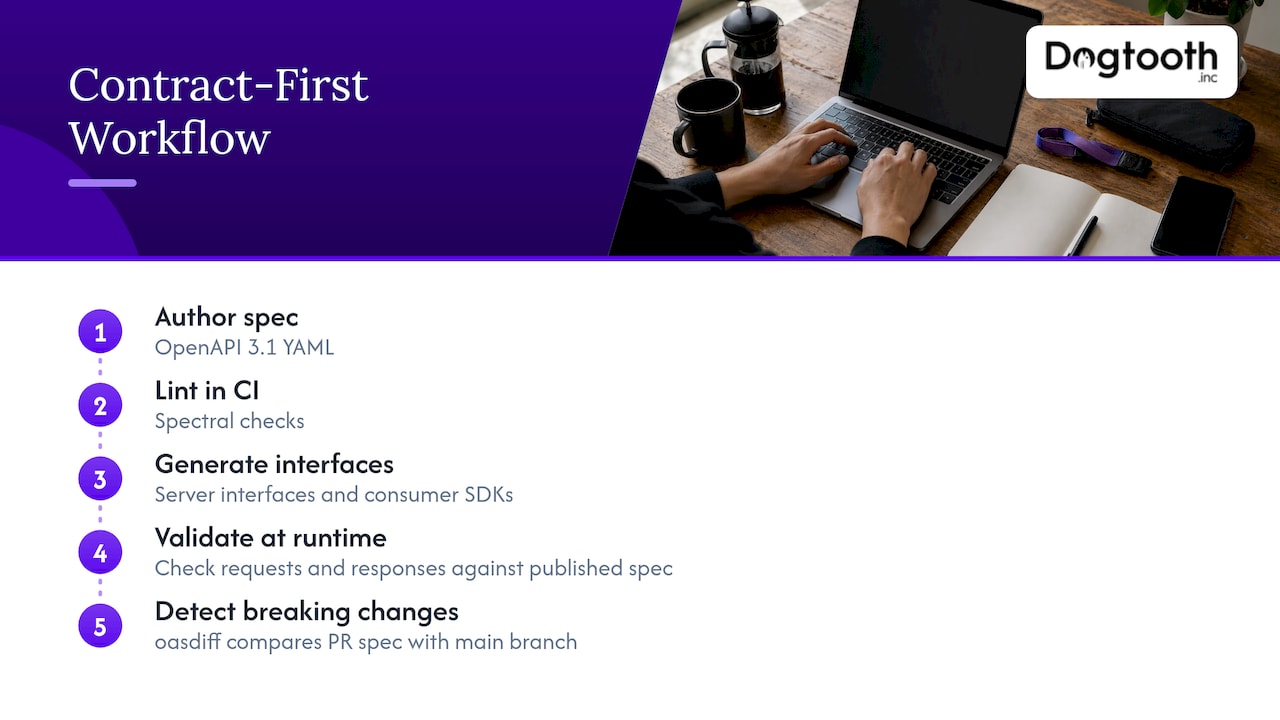
One published contract-first workflow breaks it into five phases: authoring the spec in OpenAPI 3.1 YAML, linting it with Spectral in CI, generating server interfaces and consumer SDKs, validating requests and responses against the published spec at runtime, and detecting breaking changes with oasdiff by comparing a pull request’s spec to the main branch. You do not need that exact toolset. You do need the pattern: lint, generate, validate, diff, all automated.
What makes a contract strong
Red Hat’s developer team says a strong contract meets five criteria:
- A full list of operations, inputs and outputs is documented in an OpenAPI file or comparable standard.
- Developers can track and detect breaking changes.
- The API uses semantic versioning (X.Y.Z).
- All error states are described and defined.
- Examples are current and cover every possible state.
Use that list as a review checklist for every spec before it ships.
API-first vs. code-first
Red Hat lists four ways teams end up documenting an API. They implement first and add documentation by hand. They annotate code to generate an OpenAPI spec (code-first). They generate a file during development and publish it. Or they create the OpenAPI file as input to the design process, which is the API-first or schema-first route, widely used by teams building large sets of APIs for many clients.
The difference shows up in what you get:
| Code-first | API-first | |
|---|---|---|
| Starting point | The application | The contract |
| Who shapes the interface | Mostly the backend team | Backend, frontend, partners, product |
| Documentation | Generated or written afterward | Written first, drives the code |
| Parallel work | Limited until the backend exists | Mocks let consumers build immediately |
| Typical risk | An API that exposes whatever the app happened to have | Upfront planning and spec governance |
Contentful’s team describes the code-first outcome bluntly: the API becomes an afterthought that often yields a less-than-optimal API and a poor developer experience. That is the practical argument. If your product will serve a web app, a mobile app, partners and internal tools, one deliberately designed interface beats four ad hoc ones.
Designing APIs for microservices
APIs are the interface layer that lets microservices communicate and share functionality, and API-first means defining those connections before the rest of the work. Microsoft’s Azure Architecture Center explains why this matters: all data exchange between services happens through messages or API calls, independent teams design the services, so API semantics and versioning schemes must be defined clearly to avoid breaking other services when one is updated.
Draw boundaries around data
A practical rule from one practitioner write-up: each microservice owns its data, with a single writer per dataset. If two services write to the same tables, you do not have two services, you have a distributed monolith with extra network hops. Define the contract so other services read through the API, never around it.
Pick the right protocol for each audience
Microsoft separates public APIs, which client applications call (most use REST over HTTP), from back-end APIs used between services, where serialization speed and payload size matter more. For internal calls, gRPC, Apache Avro and Apache Thrift offer binary serialization and better efficiency than HTTP. With Protocol Buffers, breaking changes are caught at build time and compatibility rides on field numbering, while REST usually evolves through URL versioning or content negotiation.
A sensible default: REST with OpenAPI at the edge, where partners and browsers need familiarity, and a binary protocol inside where latency and payload size count. For event-driven flows, use AsyncAPI or a schema registry as the contract language.
Evolve without breaking consumers
The compatibility rules are simple to state:
- Prefer additive changes within a version.
- When a breaking change is unavoidable, bump the version, run both versions side by side, publish a migration guide and set a sunset date.
- Require idempotency on commands, so a duplicate request with the same key is treated as a no-op, and carry trace data on every message, as one engineer’s redesign guide recommends.
If you are carrying an older system and cannot rewrite it in one go, we wrote up an incremental route in API modernization without a big bang, using OpenAPI and the strangler fig pattern. The same principle applies when you split a monolith: each seam gets a contract first.
Keep the layers separate
Publishing or syncing content across systems through several API layers is a common real-world use of this idea. The layered approach to API-led integration is one example of how independently built pieces connect through stable interfaces instead of point-to-point glue.
API gateway best practices
An API gateway is a centralized entry point between clients and your services. Per Microsoft, it acts as a reverse proxy that routes requests to the right service and handles cross-cutting tasks such as authentication, SSL termination, mutual TLS and rate limiting. Harvard’s enterprise architecture team calls the gateway pattern the most effective design for coordinating and controlling internal API data flows, centralizing authentication, monitoring and rate limits behind one point of entry.
Practices that hold up:
Security. Terminate TLS at the gateway, use mutual TLS where services must prove identity, and enforce OAuth2 and JWT validation centrally. Governance guidance commonly lists OAuth2, JWT, authorization, encryption and data masking as the core security policies. Because APIs are now a perimeter, CISOs are pairing tools with organization-wide policies, API inventories, automated checks and strong identity and access control.
Traffic management. Apply rate limiting, throttling and quotas at the gateway so one noisy client cannot starve the rest.
Validation. Check requests against the same OpenAPI or JSON Schema your contract publishes. The spec you designed first now does enforcement work too.
Versioning. Route versions explicitly and keep deprecation rules in the gateway policy, not in tribal memory.
Observability. Log every request with trace identifiers, and capture analytics and audit trails for traceability.
Operations. Microsoft recommends choosing a gateway that supports the features you need, preferring built-in platform offerings or managed services where they meet your security and control needs, and managing routing and security changes through infrastructure-as-code.
Keep the gateway thin
A gateway adds a possible single point of failure and an extra network call. Microsoft’s .NET guidance says that cost usually matters less than letting a chatty client call internal microservices directly. The same page quotes an Azure architect’s warning that a heavily coupled gateway can become “the new ESB”. So keep business logic in services, run the gateway redundantly, and split it by client type if one gateway starts accumulating special cases.
Adopting API-first across an organization
PayPal’s transformation is the most cited case. It had top-down pressure from the CTO, CEO and technology VPs, an API maturity model scored 1 to 5 on objectively verifiable criteria, and a habit of treating APIs as products that need ongoing support. A PayPal engineer’s point in the same article: better tooling and standards are necessary, but they do not by themselves change what the service portfolio is capable of building.
A workable adoption path for a mid-sized company:
- Start with one journey. Pick a customer-facing flow, such as checkout, booking or onboarding, and write its contract first.
- Set standards early. Naming, error format, pagination, auth and versioning rules, enforced by a linter in CI.
- Make specs discoverable. Harvard’s principles say APIs should be discoverable, reusable, modular and de-coupled, so a developer can find an existing API before building a new one.
- Assign owners. Every API has a team accountable for its lifecycle.
- Fund it as a product. McKinsey notes API teams need a dedicated agile operating model, shifting from one-off projects to products that evolve, and warns that programs siloed around only data or only cloud migration generate incremental value.
Tradeoffs to plan for
API-first rewards planning, and the planning is real work. TechTarget lists considerable upfront planning, dedicated IT leadership and C-suite buy-in among the challenges, plus careful integration and testing. If spec, mocks, test automation and documentation drift apart, the system fills with mismatched code.
SS&C Blue Prism adds four practical pressure points: dependence on consistent design (without naming standards, version control and lifecycle management you get API sprawl), integration complexity, governance gaps over who owns and audits each API, and cultural readiness.
If you work in healthcare or financial services, plan the security review early. The same source notes that exposing APIs there can widen the attack surface, shift control boundaries and trigger recertification, which can turn a simple integration into months of work. Involve compliance when you write the contract, not after.
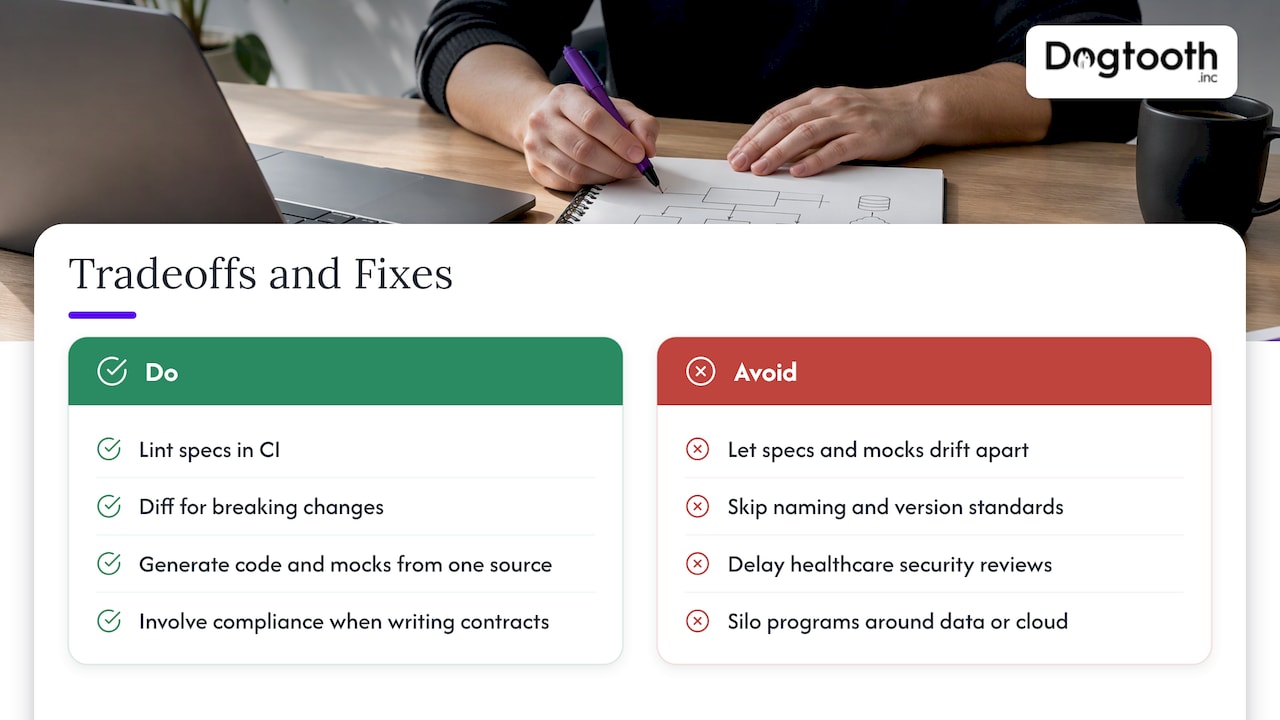
The fixes are mostly mechanical: lint specs in CI, diff them for breaking changes, generate code and mocks from one source, and publish an inventory. Teams that automate those four things keep the benefits and avoid most of the drift.
Our perspective
We build custom platforms, migrations and AI agent systems, and the pattern we see is consistent: the projects that scale are the ones where the interface was agreed before the build.
An AI agent that books sessions, charges cards and sends invites for three brands at once only works because the systems underneath expose clean, predictable interfaces. Agents need contracts as much as developers do. A typed, documented API with explicit error states gives an agent something it can act on safely. A tangle of undocumented endpoints does not.
We also run our own operation this way. Our in-house AI campaign manager drafts emails, runs compliance checks, tests inbox delivery and schedules sends on a single approval, and each step talks to the next through a defined interface.
For legacy systems, our advice is to wrap, specify, then replace. Write the contract for what the old system does today, put it behind a gateway, and move pieces behind that contract one at a time. Our senior team stays on after launch because a contract is a living thing: versions, consumers and owners keep changing.
Chase Weir
Build on a contract with Dogtooth
If your platform is stuck on outdated systems, or your e-commerce stack and internal tools do not talk to each other cleanly, we design and build the interfaces first. Our work spans platform builds and migrations, custom web apps, e-commerce engineering, integrations and APIs, and AI agents that work inside real workflows. Our senior-led team ships weekly and stays on after launch. See how it fits your stack on the Dogtooth Inc site.
For a concrete example, read how we moved a Drupal 6 research platform to a modern stack, or how we connected a craft brewery’s POS and Shopify store. If you plan to put AI agents on top of your APIs, our guide to AI agent safety and runtime controls covers what to put in place first.
FAQ
Is API-first the same as microservices?
No. API-first is a design discipline: define the contract before the code. Microservices are an architecture style. They pair well because services built by independent teams need clear contracts, but you can use API-first on a single application or a modular monolith.
What is the difference between API-first and design-first?
In most usage they overlap. Design-first, also called contract-first or schema-first, means designing the interface before writing code. API-first goes a step further by treating the API as a product with consumers, owners and a lifecycle, not only a document written up front.
Do I need an API gateway to be API-first?
Not strictly, but it becomes valuable once several clients call several services. A gateway centralizes authentication, rate limiting, routing and monitoring, so each service does not reimplement them. Keep it thin and deploy it redundantly.
Which spec format should I use?
Use OpenAPI for synchronous REST APIs and keep the file in the repository beside the service. For event-driven messaging, use AsyncAPI or a schema registry. If internal services need compact, fast calls, a binary contract such as Protocol Buffers is common.
How do I introduce API-first to an existing system?
Start with one high-value journey, write its contract, and put it behind a gateway. Then move functionality behind that contract piece by piece instead of rewriting everything. Add spec linting and breaking-change checks to your CI pipeline from the first contract.
Sources
- What is API-first? The API-first Approach Explained (Postman)
- Understanding API-First Development (Tanzu)
- Should you adopt an API-first approach to development? (TechTarget)
- When To Use an API-First Strategy (SS&C Blue Prism)
- An API-first approach to building Node.js applications (Red Hat Developer)
- Why API-first is the key to fast development and scalable applications (Contentful)
- API Design, Azure Architecture Center (Microsoft Learn)
- API gateways, Azure Architecture Center (Microsoft Learn)
- The API gateway pattern versus direct client-to-microservice communication (Microsoft Learn)
- How Zalando Delivers APIs with Radical Agility (InfoQ)
- Untangling an API-First Transformation at Scale (InfoQ)
- API Principles & Practices (Harvard Enterprise Architecture)
- The seven make-or-break API challenges (McKinsey)
- APIs are the new perimeter (CSO Online)
- API Governance Policies and Standards Guide (API7.ai)
- Contract-First API Development: OpenAPI 3.1
- Microservices Without Drama: Practical Patterns That Work
- Microservices vs Modular Monolith: Redesign Guide for Teams
- gRPC vs REST: When to Use Each API Protocol