A B2B ecommerce strategy is your plan for selling to other businesses online: who you sell to, how they buy, which platform and systems support that, and how you measure results. The strongest plans treat the website as one part of a route to market, not the whole project. This guide walks through the decisions in the order you will face them.
TL;DR
- Start with buyer research, not platform demos. Your buyers’ ordering habits decide your pricing, catalog and checkout rules.
- Choose a platform on B2B capabilities: account roles, contract pricing, approvals, reorders and ERP or CRM connections.
- Connect ecommerce to inventory, finance and customer data, or your team will re-key orders by hand.
- Match marketing to the buying journey: education first, self-service in the middle, account-based retention after the sale.
- Track a short set of metrics tied to revenue and operations, and review them on a fixed schedule.
Table of Contents
- What a B2B ecommerce strategy actually covers
- Step 1: Research your buyers before you choose anything
- Step 2: Choose the platform on B2B capabilities
- Step 3: Design the buying journey around pricing and order rules
- Step 4: Connect ecommerce to the systems behind it
- Step 5: Attract, convert and retain with the right tactics
- Step 6: Measure what drives revenue and efficiency
- A phased roadmap
- Build your B2B ecommerce platform with Dogtooth
- FAQ
- Sources
What a B2B ecommerce strategy actually covers
B2B ecommerce is the online sale of products or services between businesses, including manufacturers, wholesalers and distributors selling through websites or marketplaces. The strategy is the set of choices that make that buying process easy, personal and smooth for the company on the other side.
That is different from a consumer store in ways that shape every decision. Orders are larger and repeat. Prices are often negotiated or tiered. Several people in one customer company may need to approve a purchase. Payment may run on terms rather than a card at checkout.
Forrester describes B2B ecommerce as a complex route-to-market initiative that needs a structured process and several stakeholders across initiation, preparation and implementation. Read that as a warning against treating it as a web design job. Sales, finance, operations and IT all own a piece.
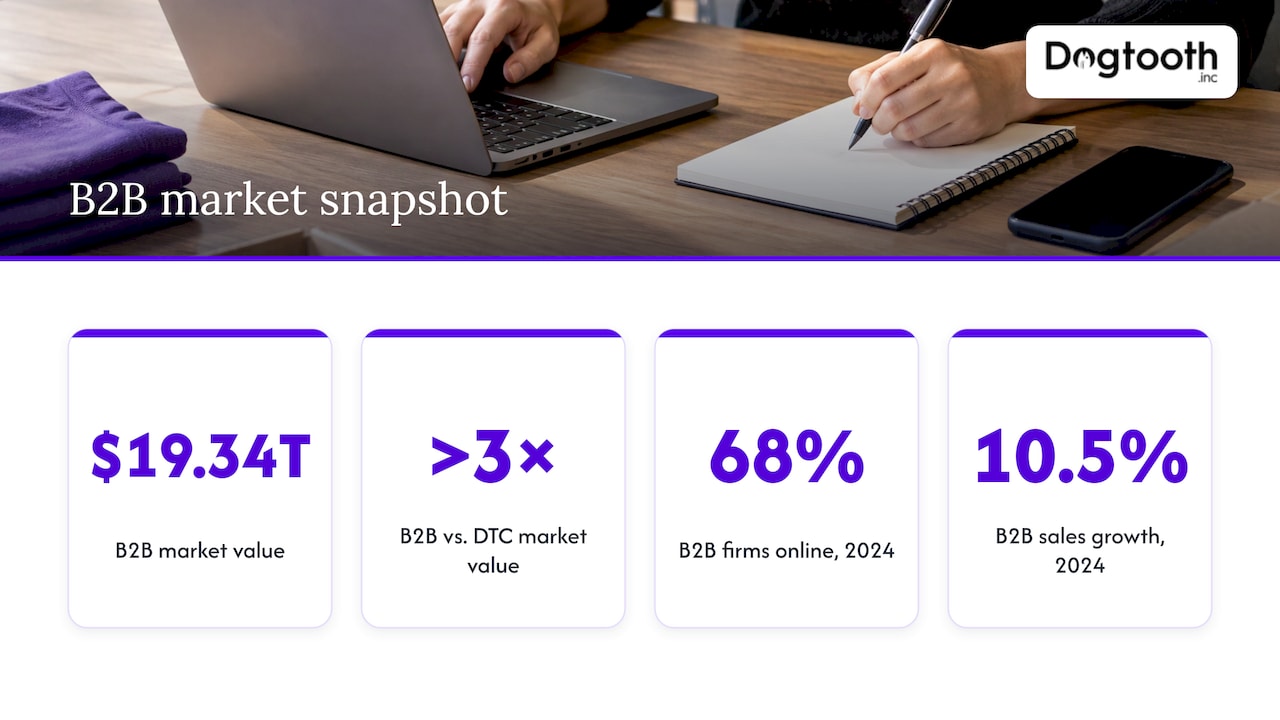
The upside is large. One estimate puts the B2B ecommerce market at $19.34 trillion, more than triple the value of DTC, and the same source reports that 68% of B2B firms ran an ecommerce site or self-service portal in 2024. Another report notes that B2B ecommerce sales grew 10.5% in 2024. Your buyers are already online. The question is whether your experience is ready for them.
The operational case matters as much as the commercial one. A good strategy helps customers buy faster while producing cleaner orders, better data and less manual administration. A weak one simply moves your offline inefficiencies onto a website.
Step 1: Research your buyers before you choose anything
Most failed B2B stores copy a consumer checkout and hope. Avoid that by learning how your customers really buy.
A workable research plan, following standard B2B market research practice:
- Define what you need to learn and which accounts matter most.
- Mix quantitative and qualitative methods. Surveys cover company profile, needs, how they use your products and how they decide. Interviews give you the detail behind the numbers.
- Talk to every role in the buying committee: the person who orders, the person who approves, the person in finance.
- Interview customers you lost as well as those you won.
A published enterprise research example combined buying-committee interviews, win-loss interviews, surveys, competitive benchmarking, pricing and packaging trade-offs, and channel mapping. You do not need that scale. Ten honest customer conversations will surface most of what you need.
Write down the answers that change the build:
- How often do customers reorder, and do they reorder the same items?
- Who approves spend, and at what threshold?
- Which payment terms do they expect?
- What do they still phone or email your sales team to do?
That last list is your first feature backlog. Every call you can remove is a self-service feature worth building.
Step 2: Choose the platform on B2B capabilities
Platform choice follows buyer research, not the other way around. When you evaluate options, look for a scalable, composable architecture and these capabilities, as listed in TechTarget’s guide to choosing a B2B platform:
| Capability | What it solves |
|---|---|
| Account hierarchies and role-based access | Several buyers, approvers and locations under one customer |
| Contract and tier pricing | Negotiated and volume prices shown correctly at login |
| Quote-to-cash workflows | Quotes that become orders without re-entry |
| Credit limits and payment terms | Net terms and limits enforced automatically |
| Punchout catalogs and approval workflows | Procurement systems and spend controls |
| Bulk and reorder tools, saved carts | Fast repeat purchasing |
| ERP and CRM integration | One source of truth for stock, price and customer data |
The same guide also recommends testing buyer flows such as configurators, real-time inventory, transparent pricing and order tracking before you commit.
In practice, a mainstream platform such as Shopify or WooCommerce covers many mid-market B2B needs, and custom work fills the gaps: special pricing logic, a customer portal, or a connection to an older back-office system. Our dual-platform Shopify and WooCommerce store shows how two stores can run side by side. If you are leaving an older platform, our guide to moving from Magento to Shopify covers costs, SEO risks and a migration plan.
Step 3: Design the buying journey around pricing and order rules
B2B buyers do not follow a straight line. One estimate says B2B buyers commonly use 10 or more channels on the path to purchase, and the same source says most prefer remote and self-serve options over a return to mainly in-person sales. Build for that reality.
A journey that serves different customer types usually has three parts:
- Front end: educational content that helps a buyer understand the problem and shortlist you.
- Middle: self-service that removes friction: tiered pricing, reorder tools, multi-user approvals, real-time stock and a clear path to bulk ordering.
- Back end: account-based retention, meaning proactive reorders, account reviews and usage-based outreach.
Pricing rules to decide early
Pricing is where B2B projects stall, so settle these questions before design starts:
- Do customers see list price, their own price, or a quote request?
- Which tiers exist: volume, contract, customer group?
- How do minimum order quantities and unit-of-measure rules work?
- Who can override a price, and where is it logged?
If prices live in a spreadsheet or an ERP, the website must read from that source. Maintaining a second price list is how wrong invoices happen.
Reorders and approvals
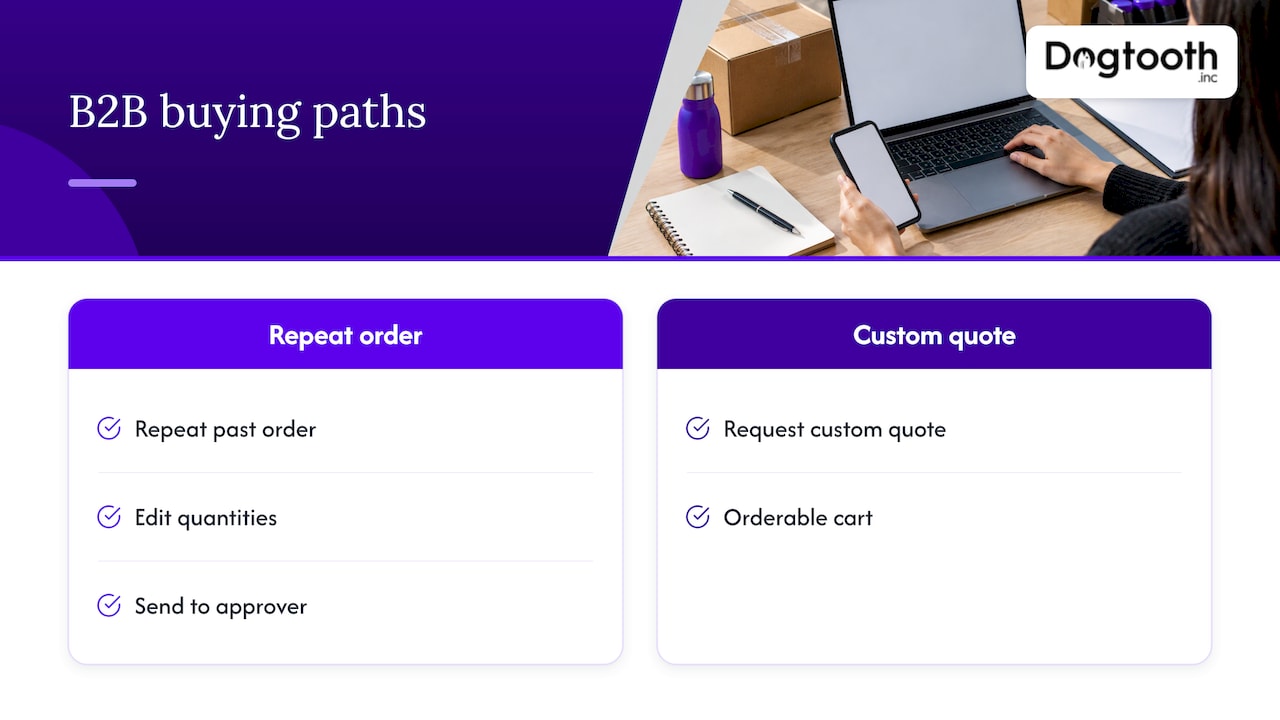
Most B2B revenue comes from repeat orders, so a fast reorder path is worth more than a polished homepage. Let a buyer repeat a past order in a couple of clicks, edit quantities and send it to an approver. Where buyers ask for custom quotes, give them a request flow that ends in an orderable cart rather than an email thread.
Personalization helps here when it is built on real account data. Our guide to AI personalization for ecommerce explains how to build it well.
Step 4: Connect ecommerce to the systems behind it
A B2B store that does not talk to your ERP, CRM, inventory and shipping tools creates work instead of removing it. Orders get re-keyed, stock counts drift and customers email to ask where their shipment is.
Plan the integration map before development:
- Product and pricing data: which system is the master, and how often does it sync?
- Inventory: real-time or scheduled, and by warehouse or location?
- Orders: how they flow into fulfillment and accounting, and how status flows back to the customer.
- Customers: how accounts, credit terms and contacts stay consistent between CRM, ERP and the store.
- Payments: cards, ACH, invoicing and terms, and how each reconciles.
Treat the work as infrastructure, not as a launch task. A cloud migration checklist is a good model for the discipline: inventory what you have, sequence the moves, test, and plan rollback before you cut over.
We have seen this pattern in our own client work. In our craft brewery POS and Shopify integration, the point was to connect point-of-sale and online sales so the business ran from one picture. For wholesale and account-based models, our practitioner portal with Stripe Connect payouts shows the same idea applied to a portal where professionals order and get paid.
Do not skip tracking. If you cannot attribute an order to a campaign or an account, you cannot judge your marketing. Our guide to GA4 ecommerce tracking covers events, setup and testing.
Step 5: Attract, convert and retain with the right tactics
B2B marketing tactics that fit an ecommerce strategy, per Shopify’s B2B marketing guide, include educational content, SEO, social and paid media, email marketing and automation, account-based marketing, loyalty programs and omnichannel personalization.
Pick by stage rather than trying everything:
- Attract: publish content that answers the questions buyers ask before they talk to anyone. Product specifications, compatibility guides and buying checklists work well. Treat SEO for category and product pages as a technical job, with clean structure and crawlable catalogs.
- Convert: make the first order easy. Offer account setup, a quote path and visible pricing rules. Follow up quickly on abandoned carts and quote requests.
- Retain: use email and automation tied to order history, such as reorder reminders and restock alerts. Assign account managers to your largest customers.
Consistency matters more than cleverness. A steady content rhythm builds trust with a buying committee that may take months to decide. If you run several channels, help keep messaging aligned so each channel supports the others.
Email deserves special care in B2B. Reorder reminders and account updates only work if they reach the inbox, so monitor deliverability as you would any other system.
Step 6: Measure what drives revenue and efficiency
Pick a short list and review it on a schedule. Marketing-side measures named in Shopify’s guidance include target account engagement, MQL to SQL conversion rate, pipeline generated, customer acquisition cost and deal velocity.
Add operational measures that show whether self-service is working:
| Area | Metric | Why it matters |
|---|---|---|
| Revenue | Share of orders placed online | Shows adoption of self-service |
| Revenue | Repeat order rate and average order value | Shows account health |
| Efficiency | Orders needing manual correction | Shows integration quality |
| Efficiency | Support requests about order status | Shows whether tracking works |
| Acquisition | Cost per new account | Keeps spend honest |
Set a baseline before launch. Without it you cannot say whether the new experience improved anything. Review monthly with sales, finance and operations in the same room, since each sees a different part of the picture.
A phased roadmap
You do not have to launch everything at once. A sensible order:
- Foundation: buyer research, pricing rules, integration map and success metrics.
- First release: account login, customer-specific pricing, catalog, reorders and order tracking for a small group of existing customers.
- Expansion: approvals, quotes, payment terms, punchout and wider rollout.
- Optimization: personalization, automation, and analytics-driven improvements.
Starting with existing customers is the safest path. They give honest feedback, and they move the highest volume.
What we have learned building this
Most B2B ecommerce trouble is not a storefront problem. It is a workflow problem that shows up on the storefront. Pricing sits in one system, stock in another, approvals in someone’s inbox. A new site on top of that just makes the mess visible faster.
That is why we start from the operation. We run our own business the way we build for clients: AI agents inside real workflows, drafting, checking, booking and reporting. One of those systems books sessions, charges cards and sends invites for three brands at once. Our AI booking system for three combat sports brands is built on that principle. Automating the repetitive steps frees your team for the parts of B2B that need judgment.
We also believe in staying on after launch. A B2B platform is never finished, because your customers, pricing and systems keep changing. Our senior team ships weekly, so improvements arrive in small, testable pieces rather than a risky big-bang release. If you are weighing where automation fits, our piece on AI agents for ecommerce shows where they work well.
Chase Weir
Build your B2B ecommerce platform with Dogtooth
Dogtooth Inc. builds custom platforms, legacy migrations, ecommerce engineering and AI automation for brands with real volume. For B2B ecommerce, that can mean a Shopify or WooCommerce build, a customer portal, integrations to your ERP and back office, and the tracking that shows what is working.
If your current system is slowing your sales team or your customers, talk to Dogtooth about your platform. We can also show how we handled high-pressure launches, such as a film launch with 180+ orders in the first six hours.
FAQ
What is the first step in a B2B ecommerce strategy?
Start with research on your existing customers: how they order, who approves, which terms they use and what still requires a phone call. Those answers set your pricing rules, features and platform shortlist. Skipping this step is the most common reason a B2B store goes live and sees little use.
How is B2B ecommerce different from B2C?
B2B sales involve other businesses, often with bulk orders, custom pricing and longer sales cycles. Several people may be involved in one purchase, and payment terms are common. That means features like account roles, contract pricing, approvals and reorder tools matter more than they do in a consumer store.
Which platform features matter most for B2B?
Look for account hierarchies, contract and tier pricing, quote-to-cash workflows, credit limits and payment terms, approval workflows, reorder tools and ERP or CRM integration. TechTarget’s platform guide lists these and suggests testing them in realistic buyer flows. Rank them by what your own customers need.
Do I need custom development?
It depends on how unusual your pricing, approvals and back-office systems are. Many companies use a mainstream platform for the storefront and add custom integrations or portals where their process is specific. A short discovery phase will show which parts need custom work.
Which metrics should I track first?
Start with share of orders placed online, repeat order rate, average order value, cost per new account and the number of orders needing manual correction. Add pipeline and deal velocity if your sales team is involved in larger accounts. Set baselines before launch so you can see the change.
Sources
- How To Build a Successful B2B Ecommerce Strategy
- Drive B2B Growth With E-Commerce: A Six-Step Process for Success (Forrester)
- Effective B2B E-commerce Strategy for Business Growth
- What is B2B e-commerce? A practical guide
- What Is B2B Ecommerce?
- Conducting B2B Market Research the Right Way
- B2B Market Research for an Enterprise Solutions Provider
- How to choose a B2B e-commerce platform (TechTarget)
- B2B Omnichannel Strategy 2026
- B2B Ecommerce Marketing: 11 Strategies