AI content moderation uses machine learning models to scan text, images, audio, and video, score how likely each item is to break your rules, and then allow it, block it, or send it to a person. Done well, it clears the obvious cases in milliseconds and leaves your team the hard calls. Done badly, it over-blocks good users, misses real harm, and gives you a public claim you cannot back up. This guide covers how the pieces fit, where systems break, what US regulators have said, and how to design a setup you can defend.
TL;DR
- Treat AI moderation as a triage layer, not a judge. Automate clear violations and clear passes, and route low-confidence and borderline items to trained people.
- Policy enforcement should be active, not after the fact: block or hold an action before it ships, and default to blocking when the system is unsure or lacks authority.
- Log every decision with the rule, the score, the model version, and the human override. In the US, the FTC expects you to substantiate what you say your AI does.
- Test in the languages, slang, and communities you actually serve. English-trained models often fail elsewhere.
- Never advertise your moderation as world class unless you can prove it with your own measured results.
Table of Contents
- What AI content moderation actually does
- Why automation is accelerating, and why people still matter
- The failure modes to design against
- What US regulators have said about moderation claims
- Policy enforcement: from reporting to blocking
- How to build a moderation workflow that holds up
- Our perspective
- Moderation beyond user posts: agents, bookings, and multilingual sites
- Build it with us
- FAQ
- Sources
What AI content moderation actually does
Strip away the vendor language and a moderation system does four jobs:
- Detect. Classifiers and language models read content and assign labels such as harassment, spam, self-harm, sexual content, or fraud, each with a confidence score.
- Decide. A rules layer maps labels and scores to actions: publish, hold, blur, remove, rate-limit, or escalate.
- Escalate. Anything below your confidence threshold, or in a sensitive category, goes to a review queue.
- Learn and report. Human decisions feed back into thresholds and training data, and logs feed your reporting and audits.
The model gets the attention, but the second and third jobs decide whether your program works. A strong classifier wired to a careless rules layer will still remove the wrong things.
Where it is used
The classic case is user-generated content: comments, reviews, profile photos, community posts, chat. A second case has grown quickly: moderating what your own AI produces. If you run a chatbot, a booking assistant, or a drafting agent, the content you must police includes its output and the actions it takes, not just what users type.
Pre-moderation, post-moderation, and reactive
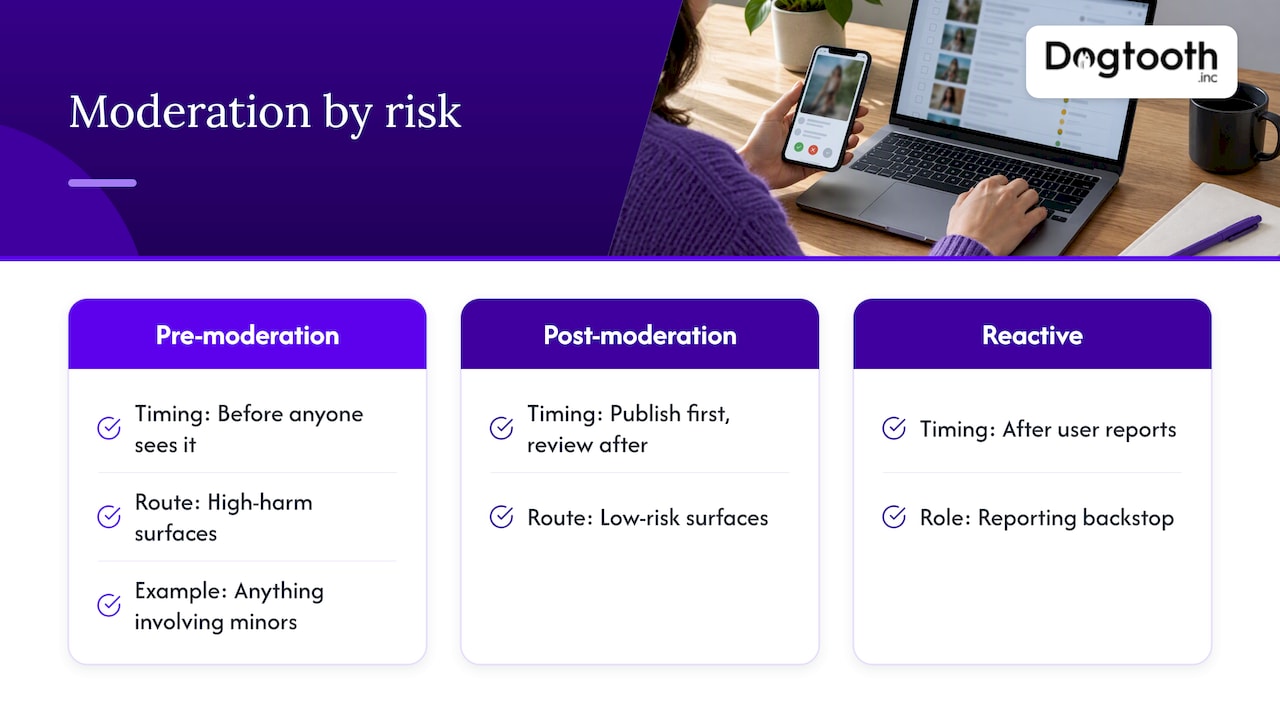
Pre-moderation checks content before anyone sees it. Post-moderation publishes first and reviews after. Reactive moderation waits for user reports. Most mature programs mix all three by risk: pre-moderate high-harm surfaces such as anything involving minors, post-moderate low-risk surfaces, and keep user reporting as a backstop.
Why automation is accelerating, and why people still matter
The pressure is volume. Internal documents obtained by NPR in 2025 indicated that a major platform planned to automate up to 90% of its risk assessments, including areas like youth risk and integrity that human reviewers had handled before. You do not need to run a platform of that size to feel the same pull: any business with a growing community or a busy support inbox hits the point where manual review cannot keep up.
The counterweight comes from digital rights researchers. In preliminary recommendations on using large language models for moderation, the European Center for Not-for-Profit Law argues that meaningful human oversight is a core accountability requirement for high-stakes decisions, and warns that mandated proactive filtering can drive over-censorship. Their direction is multi-tiered supervision: models handle speed, humans make the final calls on complex, culturally specific, or borderline content.
That is a sensible operating principle for any US business, whatever the legal setting. Speed where the answer is obvious, judgment where it is not.
The failure modes to design against
Over-blocking and under-blocking
Every threshold trades one error for another. Lower it and you remove legitimate posts, which frustrates your best users. Raise it and harmful content slips through. There is no neutral setting, so decide per category. A spam filter can tolerate a few false positives. A filter protecting minors cannot tolerate many false negatives.
The localization gap
A model that looks excellent on an English benchmark can fall apart on slang, code-mixed speech, or regional dialect. A Berkeley Center for Long-Term Cybersecurity survey of search engine safeguards notes that one-size-fits-all guardrails struggle in multilingual and multicultural settings and points to natively authored, localized safety benchmarks rather than machine-translated English test sets. A separate research effort, RabakBench, found that large language models often fail to maintain safety in low-resource language varieties such as code-mixed vernaculars, and built a benchmark with human validation to measure the gap.
The US angle is practical. If your community writes in Spanish, in Spanglish, in regional slang, or in the in-group language of a niche hobby, test with samples written by those people. Do not assume the vendor’s headline accuracy applies to you.
Bias in who gets flagged
A model can be accurate overall and still flag one group’s posts far more often than another’s. You will not see this in a single accuracy number. Comparing flag rates across groups is the useful check, and a method like selection rate ratios for AI bias shows one way to quantify that kind of imbalance. Run an equivalent comparison on your moderation outcomes before and after each model change.
Black-box decisions
If a user appeals and your team cannot say why content was removed, you have a process problem. The FTC has signaled through enforcement and its Section 6(b) orders that businesses must be able to substantiate claims about AI efficacy, bias, and safety, as summarized in the agency’s AI accomplishments report. Transparent, auditable logs are the practical answer.
What US regulators have said about moderation claims
The clearest US signal is an enforcement action, not a statute. In July 2024 the FTC and the Los Angeles District Attorney’s Office took action against NGL Labs, an anonymous messaging app aimed at teens. According to the FTC’s announcement, the order bans the company and its founders from offering anonymous messaging apps to kids under 18 and halts deceptive claims about AI content moderation. The settlement included $4.5 million in consumer redress and a $500,000 civil penalty.
The core allegation matters for anyone writing marketing copy. As the FTC’s business guidance puts it, the company promised to protect kids with world class AI content moderation, and the complaint says the AI often failed to filter out cyberbullying and similar harms. The lesson is plain: a statement about what your AI catches is a factual claim. Regulators can test it.
What this means in practice:
- Write marketing and help-center copy from measured results, not aspiration.
- Keep the evaluation data that supports each claim, with dates.
- If performance drops after a model update, update the claim.
- For anything touching minors, involve counsel before launch.
This is not legal advice. For a specific product, especially one used by children, talk to a lawyer who handles FTC and COPPA matters.
Policy enforcement: from reporting to blocking
The second phrase readers pair with this topic is policy enforcement, and it points at a real shift. Older setups logged what happened and reviewed it later. Newer designs stop the violation before it takes effect.
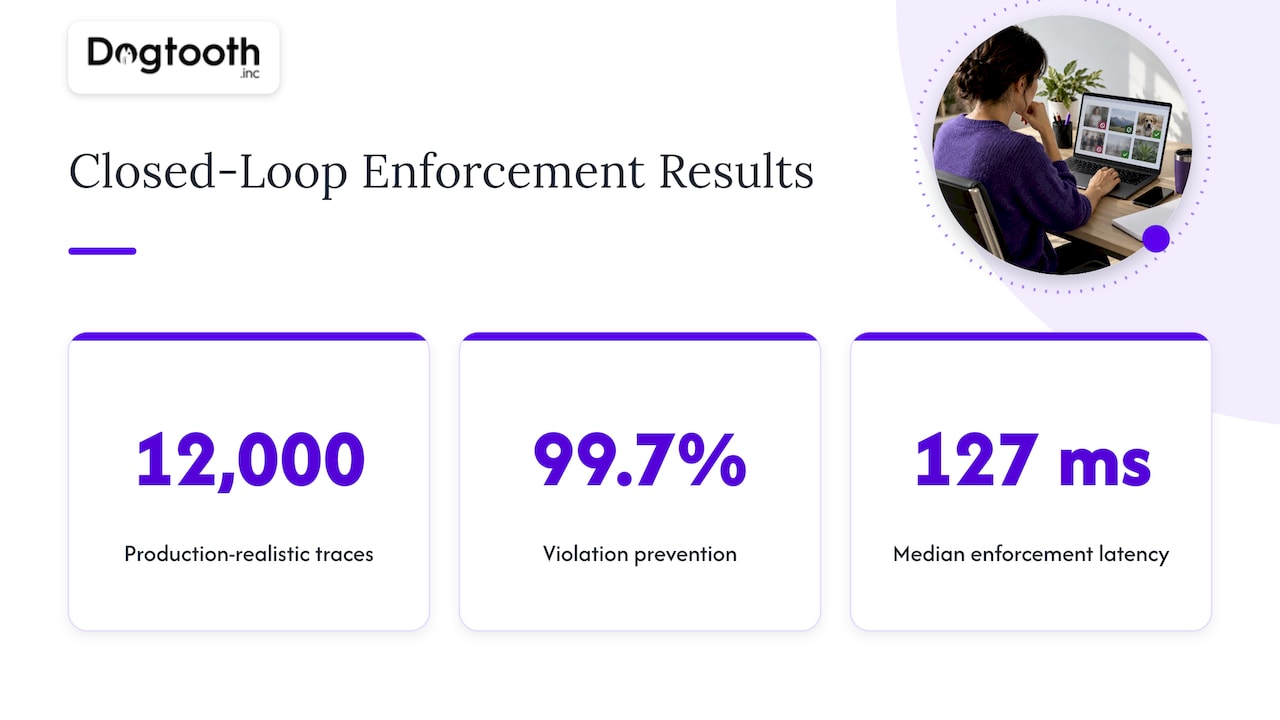
A 2026 paper on governance-aware agent telemetry describes closed-loop enforcement for multi-agent systems. In its evaluation of 12,000 production-realistic traces, the approach reached a 99.7% violation prevention rate with a median enforcement latency of 127 ms, and it used declarative, OPA-compatible rules. Those figures come from the authors’ own test scenarios, so treat them as evidence the pattern is feasible, not a promise about your stack.
An IETF draft on execution-enforcement architecture pushes the same idea: turn a governance requirement from a document into a precondition that the AI-generated action must satisfy. It also supports a fail-closed default. If the moderation agent’s confidence is low, or it lacks authority to approve the action, the safe default is to block, not to warn and let it through.
A simple enforcement ladder
| Confidence and risk | Action | Who decides |
|---|---|---|
| High confidence, clear violation | Block or remove automatically, log the rule | System, with sampled human audit |
| High confidence, clearly fine | Allow | System |
| Low confidence, low-risk category | Allow with a flag, or hold briefly | System, reviewed in batches |
| Low confidence, high-risk category (minors, violence, fraud) | Fail closed: hold or block | Human reviewer |
| Appeal by a user | Reverse or uphold | Human, not the original model |
The exact thresholds are yours to set. What matters is that the table exists, is written down, and is applied by code rather than by habit.
How to build a moderation workflow that holds up
- Write the policy first. Define each prohibited category in plain language with examples of what is in and what is out. A model cannot enforce a rule your own team reads three different ways.
- Build a labeled test set from your own content. Include your languages, slang, and edge cases. Have at least two reviewers label each item and resolve disagreements.
- Pick models by category. A general language model may suit nuanced harassment; a specialized classifier may suit image safety. Compare them on your test set, not a vendor demo.
- Set thresholds per category. Start conservative on high-harm categories and measure the review workload that results.
- Wire in the fail-closed rule. Low confidence or missing authority means hold, not publish.
- Log everything. Store the content reference, rule, score, model version, action, reviewer, and timestamp.
- Open an appeals path. A second human reviews reversals, and the outcome retrains your thresholds.
- Re-measure on a schedule. Models, slang, and attackers change. Rerun your test set after every model or policy update and compare flag rates across groups.
Sizing the human layer
The review queue is where costs and morale live. Route by confidence so reviewers see the ambiguous items, not obvious spam. Rotate people off the most disturbing categories, give them clear escalation rules, and measure agreement between reviewers. If two trained reviewers disagree often on a category, the policy text needs work before the model does.
Our perspective
We build AI agents that sit inside live business workflows: drafting, checking, booking, and reporting. Moderation is the same problem seen from another side. Every agent we ship has to know what it may do, what it may not, and what happens when it is unsure.
Three convictions come from that work. First, the control belongs inside the workflow, not in a quarterly review. An agent that can charge a card or send an invite needs its limits enforced at the moment of action. Second, humans should be placed deliberately, at the points where judgment is worth the delay. We wrote up three oversight patterns in Humans in the Loop: 3 AI Oversight Models, and the runtime side in AI Agent Safety: Enterprise Runtime Controls. Third, you earn trust by running your own operation the same way. Our in-house AI campaign manager drafts emails, runs compliance checks, tests inbox delivery, and schedules sends on a single approval, so we feel the same trade-offs our clients do.
The mistake we see most is buying a moderation tool and treating the vendor’s accuracy figure as the finish line. The finish line is a system where a decision can be explained, reversed, and improved.
— Chase Weir
Moderation beyond user posts: agents, bookings, and multilingual sites
Moderation thinking applies wherever software acts on behalf of a business. Two examples from our own work show the pattern, without claiming they are moderation products.
Our AI booking system for three combat sports brands books sessions, charges cards, and sends invites across several brands at once. An agent with that authority needs hard limits on what it can charge and whom it can email, which is the same fail-closed logic described above. We also cover the failure points in AI booking agents for businesses.
On the language side, our four-language private aviation website is a reminder that content rules cannot be written once in English and assumed to carry over. Any platform serving several language groups should plan native-language review from the start.
Build it with us
If you run a platform, community, or AI-driven workflow and need moderation, policy enforcement, or agent guardrails built into the system itself, that is our work. We design custom AI agents and integrations, ship weekly, and stay on after launch to tune what we build. Start with a conversation about your workflow at Dogtooth Inc.
FAQ
What does AI moderation mean?
It means using machine learning models to review user content or AI output against your rules, and to allow, block, or escalate it automatically. The best setups pair the model with a rules layer, a human review queue, and decision logs. The model alone is only the detection step.
Will content moderation be replaced by AI?
Mostly the routine work, yes, and that shift is already under way. Experts such as those at ECNL still argue that humans should make final calls on complex, culturally specific, or borderline content. Expect smaller human teams doing harder, higher-stakes work, not zero humans.
Can I say my product has AI moderation that works?
Only if you can prove it. The FTC treated claims about AI content moderation as factual representations in its NGL Labs action. Keep test results that back each claim, and talk to counsel before making claims about child safety.
How should AI moderation handle low-confidence cases?
Fail closed on high-risk categories: hold or block the item and send it to a trained reviewer. For low-risk categories you can allow with a flag and review in batches. Write the rule down and enforce it in code so it does not depend on who is on shift.
Sources
- NPR: Meta plans to replace humans with AI to assess risks
- ECNL: Algorithmic Gatekeepers, preliminary recommendations
- Berkeley CLTC: Survey of Search Engine Safeguards and their Applicability for AI
- RabakBench: Lost in Localization
- POPJAM.IO: Use Selection Rate Ratios to Find AI Bias
- FTC: AI accomplishments report
- FTC: Order will ban NGL Labs and halt deceptive AI moderation claims
- FTC business guidance: Anonymous messaging app targeting teens
- Governance-Aware Agent Telemetry for Closed-Loop Enforcement
- IETF draft: Technical Enforcement of the EU AI Act and Global AI Laws