AI improves customer experience when it does real work inside your systems: answering routine questions, drafting replies, booking, checking, and reporting. It does not improve it when it is a chat widget bolted onto a single database. The gains are measurable, but so are the failure modes, and most of them come from integration and oversight, not from the model.
This guide covers where AI pays off in support and e-commerce, what the data says, where customers push back, and how to design a system that holds up at volume.
TL;DR
- AI helps most where it can act across your CRM, ticketing, booking, and email systems, not where it only chats.
- A study of 5,172 support agents found a 15% average productivity gain, and 30% for less experienced agents.
- Customers want a way out: Gartner’s 2026 survey found 87% say a path to a human agent is essential.
- Legacy systems are the usual blocker, so plan the integration work before you pick the model.
- Real human oversight means a person can stop or change AI output before the customer sees it.
Table of Contents
- What AI customer experience actually means
- What the numbers say
- Where AI customer experience backfires
- Build the agent so it can act
- Human oversight that means something
- Scaling beyond cost reduction
- AI personalization in e-commerce
- Legacy systems: the step most plans skip
- Our perspective
- Work with Dogtooth
- FAQ
- Sources
What AI customer experience actually means
The phrase covers three different jobs, and mixing them up is how projects go wrong.
- Resolving interactions. An AI agent answers routine chats, emails, or calls and closes them without a person.
- Assisting people. AI drafts replies, summarizes history, and surfaces the next step for a human agent.
- Personalizing the journey. AI tailors recommendations, messages, and timing based on what a customer has done.
Each needs different data and different safeguards. A resolver needs write access to systems. An assistant needs clean history. A personalization engine needs reliable tracking. If you cannot say which of the three you are building, you are not ready to buy anything.
What the numbers say
The evidence is strongest for assistance, where a person stays in the loop.
The largest peer-reviewed study we know of followed 5,172 customer-support agents after a generative AI assistant was introduced. Productivity, measured as issues resolved per hour, rose 15% on average. Less experienced and lower-skilled agents gained about 30%, and agents with two months of tenure performed as well as untreated agents with more than six months. Highly skilled agents gained little and sometimes saw slightly lower quality.
That is a useful finding for operators. AI compresses the ramp-up time of new hires. It is not a magic multiplier for your best people.
Industry research points the same way. Metrigy’s 2025 research on SMB contact centers reports a 35% reduction in ticket volume and a 20% improvement in response times for businesses using AI tools, and describes companies where AI copilots shortened real-time interactions to about 2 minutes. Treat vendor and analyst figures as directional: they describe companies that chose to adopt and report back, not a guaranteed result for yours.
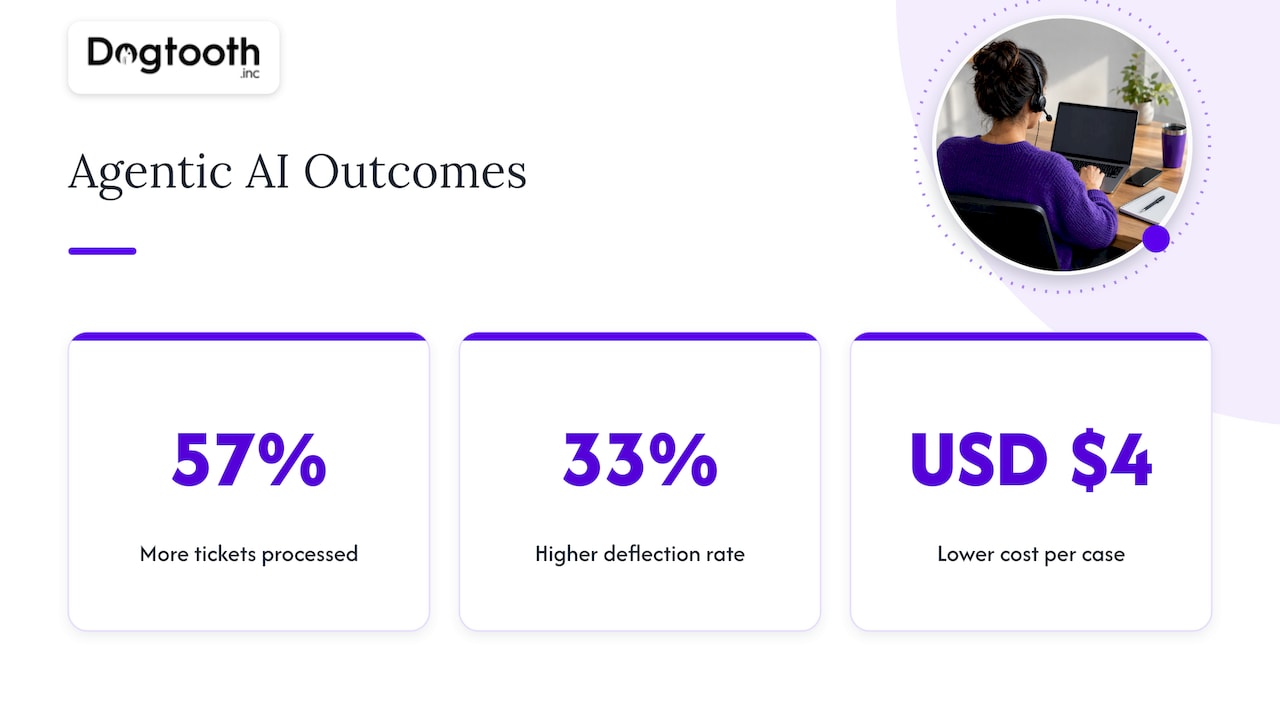
Agentic systems, which act on a customer’s behalf rather than only suggesting, show larger effects. Forethought’s 2025 benchmark, as reported by IT Brief, found companies using agentic AI processed 57% more tickets, reached 33% higher deflection rates, and cut resolution costs by an average of USD $4 per case, over 20%.
Where AI customer experience backfires
The same research shows the limits, and the customer data is blunt.
- Customers want a human option. In Gartner’s 2026 survey of 3,566 customers, 87% said companies using generative AI in service must offer a way to reach a person. The same roundup cites survey data showing most Americans prefer a human agent.
- Integration is the hard part. An expert perspective in the IT Brief coverage notes that 73% of companies report trouble connecting AI to legacy systems. A bot that cannot see the order, the booking, or the payment is a bot that apologizes.
- Fake oversight. Customer Science warns that many companies misuse the term human-in-the-loop. Real oversight means a person can verify, contest, or redirect output before it reaches the customer, not read a report afterward.
- Silos. Tools that lack cross-stack orchestration create new silos. An agent confined to one database cannot fix a problem that spans CRM, ticketing, and marketing.
Build the agent so it can act
The practical dividing line is whether the agent can do the work. Drafting, checking, booking, and reporting across several systems is what turns a conversational layer into a CX improvement.
Consider booking. A customer who wants to reschedule does not want a chat that says “I have noted your request.” They want the slot changed, the card handled correctly, and the invite resent. If you run several brands, they also want the system to know which brand they are talking to. We cover the system gaps that block this in our guide to AI booking agents for businesses, and the result in a real deployment is in our AI booking system for three combat sports brands, where one agent books sessions, charges cards, and sends invites for all three brands.
A checklist before you build
- Pick one workflow with a clear finish line. Rescheduling, order status, refund eligibility, or a lead follow-up. Not “customer service.”
- Map every system the workflow touches. CRM, payment processor, calendar, ticketing, email platform.
- Decide what the agent may do alone. Read, draft, write, charge. Each step up needs a tighter control.
- Write the stop list. Topics that always go to a person: hardship, compensation, sensitive data, legal threats.
- Define the handoff. The person who takes over should see the full conversation and what the agent already tried.
- Measure before and after. First-contact resolution, time to resolution, escalation rate, and customer rating.
Human oversight that means something
Human-in-the-loop is a design choice with several shapes. Customer Science frames it as keeping people accountable for AI-supported decisions, outputs, and exceptions: AI can speed up search, drafting, routing, and summarizing, while humans approve and override.
In practice, we think about three levels:
| Level | What the AI does | What a person does | Best for |
|---|---|---|---|
| Approve before send | Drafts the reply or action | Reviews and approves each one | New workflows, high-risk topics |
| Sample and audit | Acts alone on low-risk cases | Reviews a sample and all exceptions | Mature, well-measured flows |
| Stop list | Acts alone except on listed topics | Handles every listed case | High-volume routine support |
Most teams should start in the first row and move down as the data justifies it. Our write-up on three AI oversight models goes deeper, and AI agent safety and runtime controls covers how to enforce limits once the agent is live.
Scaling beyond cost reduction
Cutting cost per ticket is the obvious win, but it is the smaller one. When routine work is absorbed, your people can spend time on retention, complex cases, and revenue conversations. The approach to AI agent assist in contact centers is one example of proving value on a small group of agents before rolling out wider, which is the right order of operations whichever tools you choose.
The macro picture supports the framing. A multi-sector economic model of the US economy estimates that a 10% productivity increase in the generative AI sector implies a 5.6% rise in aggregate GDP, partly through better customer base management. It is a model, not a forecast for your company, but it points to the same lesson: treat AI as throughput and reach, not only as headcount savings.
AI personalization in e-commerce
Online stores are where the personalization strand of AI customer experience is most visible. According to the Shopify Merchant Survey, three out of four e-commerce owners now use AI tools, and content generation leads at 69% of those using AI. The same page cites a Nosto and Censuswide survey in which 72% of consumers expect AI shopping assistants to help them shop online.
Personalization works only as well as the data under it. Three things decide the outcome:
- Tracking you can trust. If ad platforms and your store disagree about who bought what, recommendations and spend optimize against noise. Our case study on Meta CAPI tracking across 15+ ad accounts shows what server-side attribution infrastructure looks like at scale.
- Connected store systems. Inventory, point of sale, and storefront need to agree. See how we linked them in a craft brewery POS and Shopify integration.
- Email that reaches the inbox. Personalized messages that land in spam personalize nothing. Deliverability is part of customer experience.
For teams running more than one storefront, our Shopify and WooCommerce dual-platform store shows how to keep the experience consistent across platforms.
Legacy systems: the step most plans skip
If 73% of companies struggle to connect AI to older systems, the sensible move is to budget for that work first. An agent needs clean, reachable APIs to read and write. Replacing everything at once is risky, so we favor staged approaches: API modernization without a big bang and the five phases of a legacy migration. For a concrete example, see how we moved a Drupal 6 research platform to a modern stack.
Our perspective
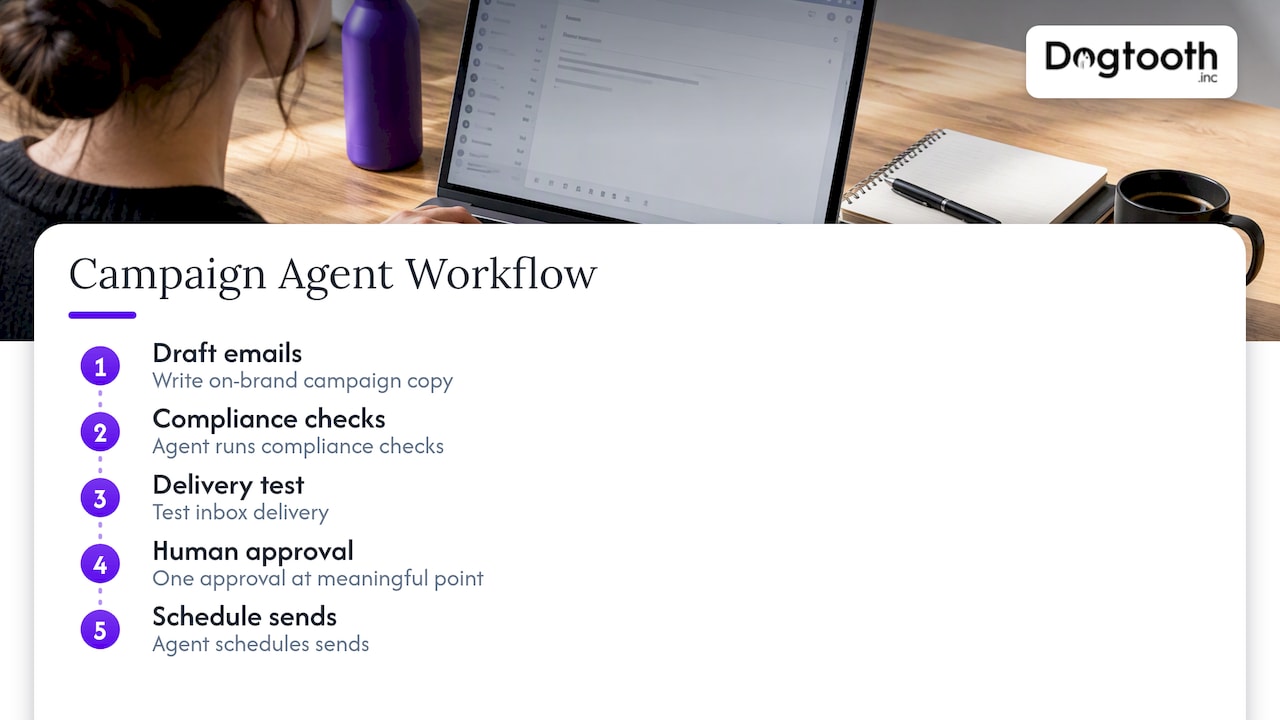
We build AI agents for clients and we run our own operation the same way. Our in-house campaign manager drafts on-brand emails, runs compliance checks, tests inbox delivery, and schedules sends on a single approval. That last phrase matters: the human approves once, at the point where approval is meaningful, and the agent handles the checking that people skip when they are busy.
Three convictions come out of that work. First, an agent earns trust by acting inside the real workflow, with the same systems your team uses, not by sitting beside them. Second, the model is rarely the bottleneck. Access, data quality, and clear limits are. Third, launch is the start. Agents need tuning as products, policies, and customers change, which is why we stay on after launch.
If you remember one thing: give the agent a job with a finish line, a stop list, and a person who owns the outcome.
— Chase Weir
Work with Dogtooth
If you are planning AI agents, a migration to a modern stack, an e-commerce rebuild, or better tracking and email deliverability, our senior team scopes and ships in weekly increments. See the full range of platform builds, web apps, e-commerce engineering, and AI agent services, including MailFurnace, our deliverability software for high-volume senders.
FAQ
Does AI improve customer experience?
Yes, when it is tied to real workflows. A study of 5,172 support agents found a 15% average productivity gain, with the biggest benefit for newer agents. Results depend on integration quality and on keeping a human route open for customers.
Will AI replace human customer service teams?
Not in the near term for most businesses. Customers still want access to a person, and the strongest evidence shows AI lifting human performance rather than removing it. The likelier change is that routine cases are automated and people focus on complex ones.
What should we automate first?
Choose a repetitive, low-risk workflow with a clear outcome, such as order status, rescheduling, or lead follow-up. Run it with approval before send, measure resolution and escalation rates, and loosen controls only as the data supports it.
Why do AI customer service projects fail?
The common causes are poor integration with existing systems, no real oversight, and an agent that can talk but cannot act. Fix access and ownership before you tune prompts.
Sources
- Generative AI at Work, Quarterly Journal of Economics
- AI Making its Mark in CX for SMBs, Metrigy
- Agentic AI helps firms boost CX satisfaction and cut costs per case, IT Brief
- AI in Customer Service Statistics, Master of Code
- Responsible AI customer service guidelines, Customer Science
- Human in the loop AI governance for customer service, Customer Science
- The macroeconomic implications of the Gen-AI revolution
- AI in Ecommerce: 7 Key Use Cases for 2026, Shopify