Cross-channel attribution is the practice of assigning credit for a sale, lead or booking across every marketing channel a customer touched on the way, instead of handing all of it to one click. Done well, it tells you where the next dollar should go. Done badly, it gives you a confident dashboard that is wrong. This guide explains how it works, how the common models differ, how to connect online and offline activity, and what to build first.
TL;DR
- Cross-channel attribution splits conversion credit across the touchpoints in a customer journey, so budget decisions do not rest on the last ad clicked.
- Single-touch models (first-click, last-click) are simple but blind to everything in between. Multi-touch and data-driven models spread credit, and marketing mix modeling covers channels you cannot track per user.
- The hard part is data, not math: connected identifiers, one naming taxonomy, consent handling and a central place to store it all.
- Start with clean server-side events and consistent UTMs, pick one model that fits your journey length, and validate it before you move budget.
Table of Contents
- What cross-channel attribution actually is
- How it works in practice
- First-click vs. last-click: the single-touch models
- Multi-touch vs. last-click
- Multi-touch attribution vs. marketing mix modeling
- Measuring online and offline touchpoints together
- The data foundation that makes any model trustworthy
- A step-by-step plan to get started
- Common mistakes
- Our perspective
- Need attribution you can trust? Let us build it
- FAQ
- Sources
What cross-channel attribution actually is
A customer rarely buys after one interaction. They see a paid social video, search your brand a week later, open an email, and finally buy after clicking a retargeting ad. Each of those is a touchpoint. Attribution is the rule set that decides how much each touchpoint gets credited with the sale.
“Cross-channel” means the rules apply across channels (paid search, paid social, email, organic, affiliates, direct, even phone and in-store) rather than inside one platform’s own reporting. That matters because every ad platform will, by default, claim the conversions it can see. Add up the claims from each platform and you often get more sales than you actually had.
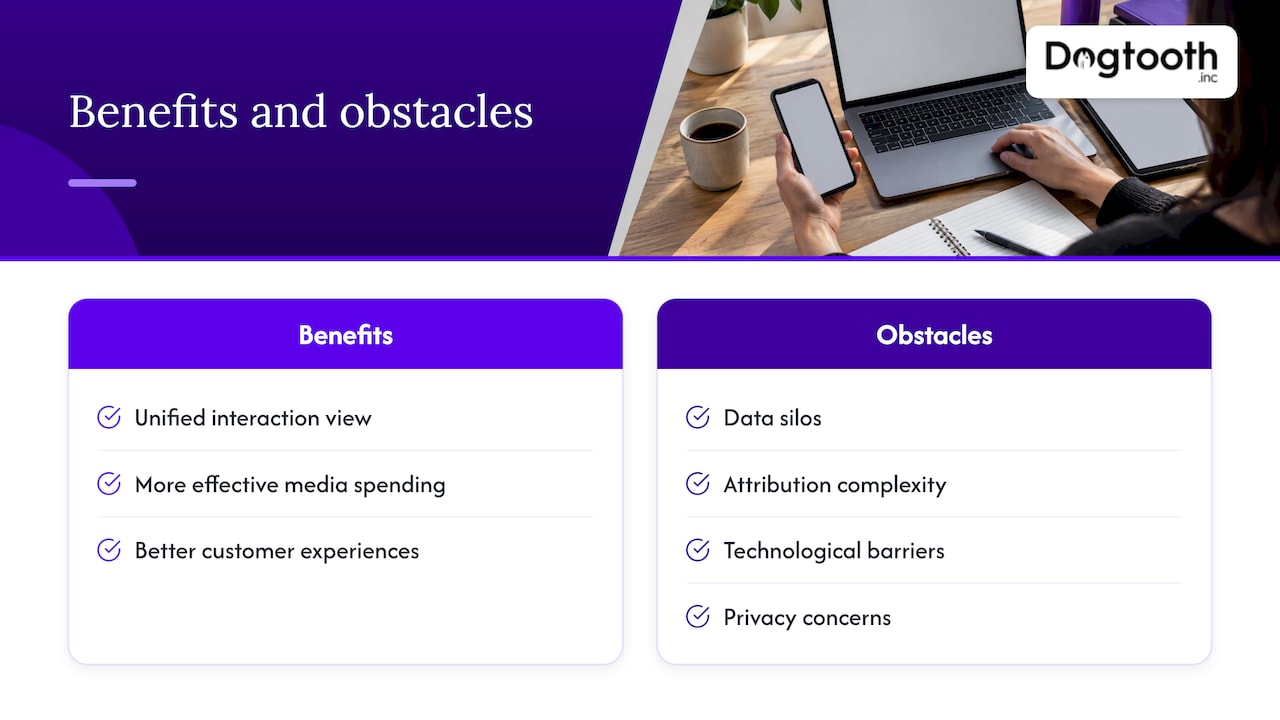
The IAB’s cross-channel measurement guidance describes the payoff in three parts: a unified view of consumer interactions, more effective media spending and better customer experiences. The same guidance lists the obstacles: data silos, attribution complexity, technological barriers and privacy concerns. Those four obstacles shape the rest of this article.
How it works in practice
Every cross-channel setup, whatever the vendor or the in-house build, runs the same four-step loop.
- Capture touchpoints. Record each exposure or interaction: ad clicks, ad impressions where available, site visits, email opens and clicks, form fills, calls.
- Resolve identity. Connect those events to the same person or household. This is usually done with first-party identifiers such as a logged-in ID or a hashed email address.
- Store it in one place. Put the events in one warehouse under one naming scheme, so “paid_social” is not “Facebook-Ads” in one report and “fb” in another.
- Apply a model. Run the journeys through a credit rule or a statistical model and report the result by channel, campaign and creative.
The IAB recommends exactly this foundation: collect comprehensive, granular data across channels, use identity resolution to connect user-level data, and centralize it in a data warehouse or lake under a unified taxonomy. If you skip steps 2 and 3, step 4 has nothing reliable to work on, and no model will rescue it.
First-click vs. last-click: the single-touch models
Single-touch models give 100% of the credit to one touchpoint.
- First-click credits the touchpoint that first introduced the person to your brand.
- Last-click credits the final touchpoint before conversion.
Both definitions come from the IAB’s cross-channel measurement guidance, which classes them as single-touch approaches.
Here is what each one does to your decisions:
| First-click | Last-click | |
|---|---|---|
| Rewards | Awareness channels: video, podcasts, organic social, content | Closing channels: branded search, retargeting, email |
| Hides | Everything that nurtured and closed the sale | Everything that created the demand |
| Best used for | Judging which channels open new relationships | Quick, simple reporting on short purchase cycles |
| Risk | Overfunds top-of-funnel | Underfunds top-of-funnel and overfunds harvesting channels |
A simple example shows the gap. Suppose a shopper discovers you through a creator video, reads two emails, then types your brand into search and buys. Last-click gives branded search the whole sale. First-click gives it all to the video. Neither is a lie exactly, but neither describes what happened, and a team that only reads one of them will keep cutting the channels the other one rewards.
If you only have bandwidth for a quick check, run both side by side for a month. Channels that look great on first-click and terrible on last-click are your demand creators. Channels that show the reverse are your closers. That contrast alone is often the first useful insight a team gets.
Multi-touch vs. last-click
Multi-touch attribution (MTA) assigns credit to several touchpoints along the journey, while last-click credits only the final one, per the IAB. The same source lists the rule-based variants you will meet most often:
- Linear: credit is split equally across all touchpoints.
- Time decay: touchpoints closer to the conversion get more credit.
- Position-based: the first and last touchpoints get a disproportionate share, with the middle sharing the rest.
On top of these sits data-driven attribution, which uses advanced computer programs to assign credit dynamically based on each touchpoint’s actual impact, rather than a fixed rule.
Which one should you choose?
The IAB’s advice is to choose a model that matches the customer journey and the data you actually have, refresh it as behavior changes, and validate it with statistical techniques. In plain terms:
- Short, low-consideration purchases (a $30 accessory): last-click or time decay is often enough, because journeys are short and there is little in the middle to credit.
- Longer journeys with several channels (a $400 product, a subscription, a B2B lead): position-based or data-driven models describe the path better.
- Low conversion volume: data-driven models need enough conversions to learn from. With thin data, a simple rule you understand beats an opaque model you cannot check.
How much does it matter? The IAB and MMA’s guidebook records panelists saying MTA studies reported performance improvements from 3% to 30% or higher, with 3% to 4% considered more realistic in an ongoing study. Treat that as a reason to set modest expectations: attribution improves allocation at the margin, and it is not a switch that doubles revenue.
Multi-touch attribution vs. marketing mix modeling
MTA is not the only way to measure across channels. Marketing mix modeling (MMM) works at the aggregate level. According to the IAB and MMA guidebook, MMM uses aggregate data to measure the impact of both online and offline media, while MTA uses user-specific, granular data to follow individual journeys. MMM tends to suit non-addressable channels like TV, and MTA gives tactical, granular insight into digital performance. The same guidebook notes MMM typically includes more touchpoints, especially offline ones such as TV, radio, out-of-home, point-of-purchase and sales promotion.
| Multi-touch attribution | Marketing mix modeling | |
|---|---|---|
| Data level | User-level, journey by journey | Aggregate, over time |
| Strongest at | Digital, tactical optimization | Offline and non-addressable channels, big-picture budget splits |
| Weakest at | Channels you cannot tie to a person | Fast, campaign-level or creative-level decisions |
| Typical question | Which ad, email or keyword is working this week? | How should we split next quarter’s budget between TV, search and social? |
Most brands with real spend end up using both: MTA for day-to-day optimization, MMM for the yearly budget conversation. If your spend is almost entirely digital and your volume is moderate, start with MTA built on clean first-party data and add MMM when offline channels become material.
Measuring online and offline touchpoints together
This is the question behind “online offline attribution,” and it is where most setups fall short. The IAB’s primer on digital attribution notes that offline purchases make up the vast majority of consumer activity relative to e-commerce, which is why advertisers care about connecting online exposure to in-store sales.
The same primer describes the main methods:
- Exposure to store visit: match cookie or device identifiers with location data.
- Exposure to offline purchase: link those identifiers to email addresses or phone numbers, then match against CRM records.
- In-store beacons: detect visits.
- Call-tracking numbers: measure phone-call conversions from specific campaigns or pages.
That primer dates from 2016, and identifier-based methods have become harder since, so lean on the part that has aged best: your own first-party data. A practical version looks like this:
- Capture an email or phone number at the earliest sensible moment (a signup, a booking, a loyalty enrollment) and attach the campaign source to that record.
- Pass the same ID through your point-of-sale or booking system, so an in-person purchase lands on the same customer profile as the ad click that started it.
- Use unique call numbers or promo codes per channel for the conversions that happen by phone or at the counter.
- Report offline conversions back into your attribution warehouse as events, with the original source attached.
The integration work in step 2 is usually the bottleneck. A good example of the shape of it is a craft brewery that tied its point-of-sale system to its Shopify store, putting taproom and online sales on one footing so they could be read together.
The data foundation that makes any model trustworthy
Whatever model you choose, these practices decide whether the output is usable.
Track conversions on the server
Browser-only tracking loses events to blockers, short cookie lifetimes and failed redirects. Recording payment confirmations from your server gives you a source of truth that does not depend on the browser behaving. We cover the mechanics in our guide to server-side tracking for marketers.
Get e-commerce events right
If purchase, add-to-cart and checkout events fire inconsistently, every channel’s numbers are off before any model touches them. Our walkthrough of GA4 e-commerce tracking covers events, setup and testing.
Reconcile platform reports against your store
Ad platforms and storefront analytics rarely agree. Comparing platform-reported revenue with actual orders is a good habit, and this piece on reconciling Shopify attribution data shows one way to approach the gap. Our rule: your order database is the ceiling. If the platforms together claim more revenue than the database recorded, the overlap is double counting.
Use one taxonomy
Agree on channel names, UTM conventions and campaign naming once, write them down and enforce them. Most “attribution problems” we see at first are naming problems: the same campaign split across five labels, or email traffic landing in “direct” because links were untagged.
Handle consent as part of the design
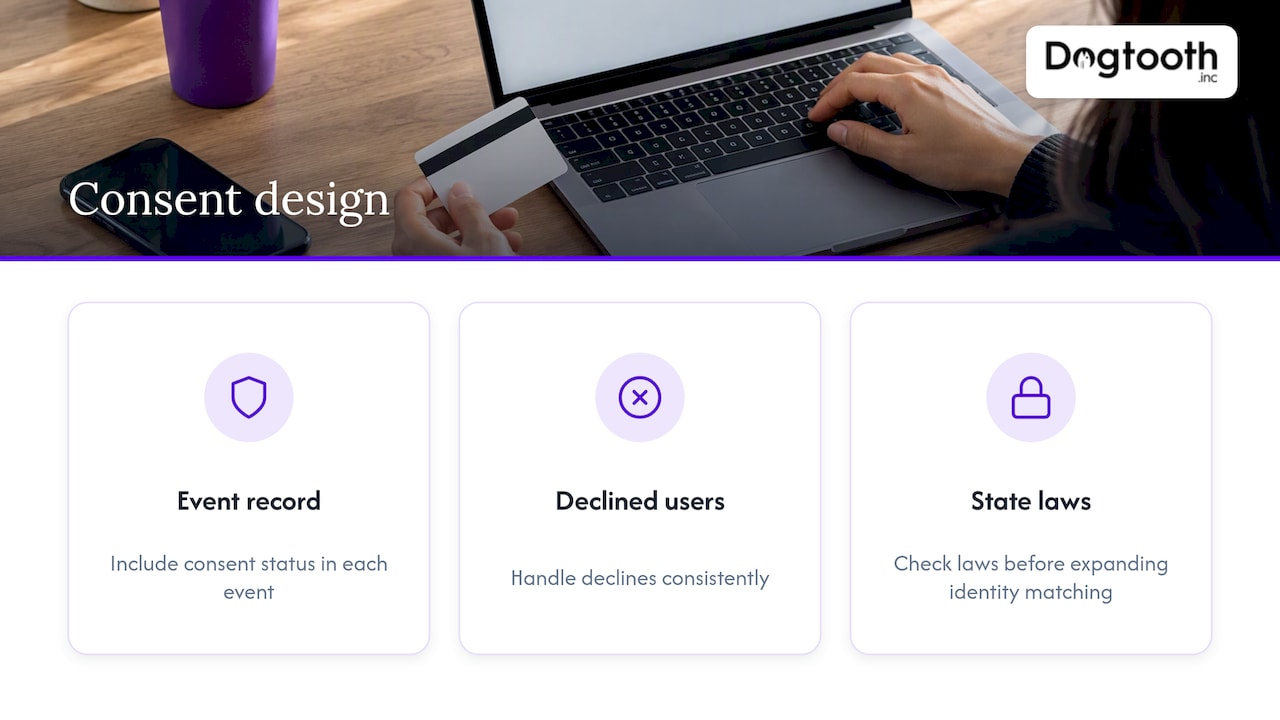
The IAB’s guidance says cross-channel measurement should include consent management and regular audits of the measurement framework. Build consent status into the event record itself, so users who decline are handled consistently and you can show what you collected and why. For US brands, check how state privacy laws apply to your audience with your counsel before you expand identity matching.
Validate before you act
Compare model output with something independent: a holdout test, a geo experiment, a pause-and-observe on one channel. If a model says a channel drives 40% of sales and pausing it moves nothing, the model needs work. Revisit the model on a schedule, because channel mix and customer behavior drift.
A step-by-step plan to get started
- List your channels and conversion points, including offline ones. Mark which can be tied to a person and which cannot.
- Fix tracking first. Tag every link, fire purchase events from the server, and test them end to end.
- Choose a central store for events, with one taxonomy and one customer ID.
- Run last-click and first-click side by side for a full purchase cycle to see where they disagree.
- Add one multi-touch model that fits your journey length, and keep the rules visible to the whole team.
- Validate with an experiment on one meaningful channel before shifting budget.
- Shift budget in small steps and watch the result against your order database.
If you want a build-it-yourself reference for this, our write-up on a privacy-aware custom attribution model lays out the steps in more depth. For the wider business case for measurement, this overview of is a reasonable companion.
Common mistakes
- Trusting each platform’s own number. Each one grades its own homework. Use your store or CRM as the arbiter.
- Crediting only what is clickable. Podcasts, creators, TV and word of mouth leave few clicks. Use post-purchase surveys and MMM to see them.
- Changing models mid-flight. Switching rules every month makes trends meaningless. Change on a schedule and annotate it.
- Over-engineering early. A clean last-click versus first-click comparison on good data beats an elaborate model on broken data.
- Ignoring email. Email often gets last-click credit simply because it reaches people who already intend to buy. Deliverability problems quietly distort those numbers too, since an email that lands in spam never gets a chance to be counted.
Our perspective
We build attribution as plumbing before we build it as analysis. Most brands that come to us do not have a model problem. They have a data problem: purchase events that fire twice, UTMs that vanish at checkout, and an email platform whose numbers never match the store.
So we start at the source. Server-side payment events, a single customer ID across the storefront, the CRM and the point-of-sale, and a warehouse where every touchpoint lands under one naming scheme. Only then do we choose a model, and we usually build it custom, because your journey, your consent rules and your channel mix are not the same as anyone else’s.
We also run our own operation this way. Our internal AI campaign manager drafts emails, runs compliance checks, tests inbox delivery and schedules sends on one approval, and we measure what it does with the same standards we bring to clients. When we say a number is reliable, it is because we have had to rely on it ourselves.
The senior team that scopes the work is the team that ships it and stays on after launch, because attribution is never finished. Channels change, privacy rules change, and the model needs to change with them.
Chase Weir
Need attribution you can trust? Let us build it
If your platforms disagree with your store, your offline sales are invisible, or your email numbers do not add up, the fix is usually engineering first and modeling second. Dogtooth Inc. designs and builds custom attribution systems, e-commerce tracking, integrations and email deliverability infrastructure for brands with real volume, and our senior team stays on after launch.

See what we build on the Dogtooth Inc. site and tell us where your measurement breaks today.
FAQ
What is the difference between cross-channel and multi-channel attribution?
The terms are often used interchangeably, and many guides treat them as the same practice. When a distinction is drawn, multi-channel usually means reporting each channel side by side, while cross-channel means connecting the channels into one journey for a single customer. The second is the harder and more useful one, because it requires identity resolution and shared data.
Is last-click attribution ever the right choice?
Yes, for short purchase cycles with few channels, or as a baseline to compare against. Its weakness is that it credits only the final touchpoint, so channels that create demand look worthless. Run it next to a multi-touch view rather than relying on it alone.
Should I use multi-touch attribution or marketing mix modeling?
It depends on your channels. MTA follows individual digital journeys and suits tactical optimization, while MMM uses aggregate data and handles offline and non-addressable media such as TV and radio. Brands with large spend across both online and offline channels commonly use the two together.
How do I connect in-store or phone sales to online campaigns?
Tie an email address or phone number to the customer record at the first opportunity, carry that ID through your point-of-sale or booking system, and use call-tracking numbers or channel-specific codes where no digital trail exists. Then send those offline conversions back into your warehouse with the original source attached.
How long does it take to see useful results?
Plan for at least one full purchase cycle of clean data before judging any model. For short-cycle e-commerce that can be a few weeks. For longer B2B or high-consideration sales it is longer. Fixing tracking comes first, since models built on broken events only produce confident errors.
Sources
- Cross-Channel Measurement Best Practices for Marketers (IAB, 2024)
- The Essential Guide to Marketing Mix Modeling and Multi-Touch Attribution (IAB and MMA, 2019)
- Digital Attribution Primer 2.0 (IAB, 2016)