AI personalization in ecommerce uses machine learning to decide, for each shopper, which products, search results, offers and messages to show. It does this from behavior such as views, clicks, cart activity and purchases, and it keeps updating as new data arrives. The two places it pays off most are product recommendations and merchandising, and both depend far more on clean data and honest measurement than on which model you pick.
This guide explains how each piece works, what evidence exists for results, how to implement it in a real store, and which U.S. privacy and operational risks to handle before you launch.
TL;DR
- AI personalization replaces hand-written rules with models that learn from shopper behavior and update in real time.
- Recommendations pick candidates, filter out ineligible items, rank for a goal, then log results. Merchandising applies the same signals to category pages, search and promotions.
- Randomized field experiments at one large retailer found fewer returns and more repeat purchases, but your store has to prove its own lift with a control group.
- Fix data quality and event tracking first. Measure revenue per visit, conversion rate and average order value against a holdout.
- In the U.S., the FTC expects you to back up AI claims and to collect and use data lawfully.
Table of Contents
- What AI personalization actually is
- How AI product recommendations choose and rank items
- AI merchandising: personalizing discovery, search and promotions
- What results to expect, and how much to trust the numbers
- Implementing AI recommendations and merchandising
- Measuring and improving personalization
- Privacy, bias and operational risks in the U.S.
- Our perspective: personalization is a workflow problem
- Build it with Dogtooth
- FAQ
- Sources
What AI personalization actually is
Personalization, at its simplest, means assigning an action to a user based on what you know about them. An academic review frames it as a range, from broad demographic segments to highly individualized strategies, and notes that finer-grained policies need larger datasets and flexible methods to learn complex patterns.
Traditional personalization is rules-based. A merchandiser writes a segment (“returning customers in the Northeast”) and assigns content to it. Adobe’s ecommerce guidance describes this as manually created segments built on basic demographics and limited behavioral data, while AI can combine richer inputs: clicks, email engagement, product views, purchases, returns and loyalty data.
The practical differences:
- Learning instead of authoring. A model learns from historical and real-time data and revises its predictions as new behavior comes in. Nobody rewrites a rule when tastes shift.
- Scores instead of segments. Models can score each shopper’s likelihood of an action such as churn and turn those scores into segments and experiences automatically, so analysts no longer define every rule.
- One-to-one results. With AI-driven search, two shoppers who type the same words can see results ranked differently based on inferred preferences and intent.
- Anticipation. IBM describes hyper-personalization as proactive: where older methods react to past data, predictive analytics anticipate needs before the customer states them.
For a concrete tour of where retailers apply this, see these , which cover browsing, purchase, click and cart signals shaping the shopping experience.
How AI product recommendations choose and rank items
A recommendation engine is two things: a data pipeline and a ranking model. Google Cloud’s retail documentation explains that these systems train on product catalog information and user events, including views, clicks and purchases, and can personalize in real time.
Most production systems follow the same four stages, as laid out in a practical build guide for recommendations:
- Generate candidates. Pull a pool of possibly relevant products.
- Remove ineligible items. Drop anything out of stock or otherwise unavailable.
- Rank for the placement goal. Order what remains for the slot: a product page, a cart, an email.
- Deliver and log. Serve the result and record performance so the model can be evaluated.
The most familiar technique is item-to-item collaborative filtering, which uses patterns such as “people who viewed or bought this also viewed or bought” to rank by similarity. Adobe’s documentation on recommendation algorithms describes it in detail.
Where recommendations show up
Recommendations are not limited to a product-page carousel. Google Cloud notes that its API model supports mobile apps, personalized email, store kiosks and call center applications. PayPal’s U.S. guidance extends the idea across the journey, naming tailored recommendations, real-time service, streamlined checkout and automated shipping and returns updates.
| Placement | Typical goal | Signal that matters most |
|---|---|---|
| Product page | Cross-sell, similar items | Current item plus what similar shoppers viewed or bought |
| Cart | Add-ons, average order value | Cart contents and purchase history |
| Search results | Faster path to the right item | Query text plus the shopper’s past views and purchases |
| Repeat purchase | Recent browsing, purchase recency, email engagement |
The catch is cold start. A new visitor with no history gets popularity-based or context-based suggestions until the system has seen enough behavior. Plan for that case rather than treating it as an edge case, because on many stores first-time visitors are the majority of sessions.
AI merchandising: personalizing discovery, search and promotions
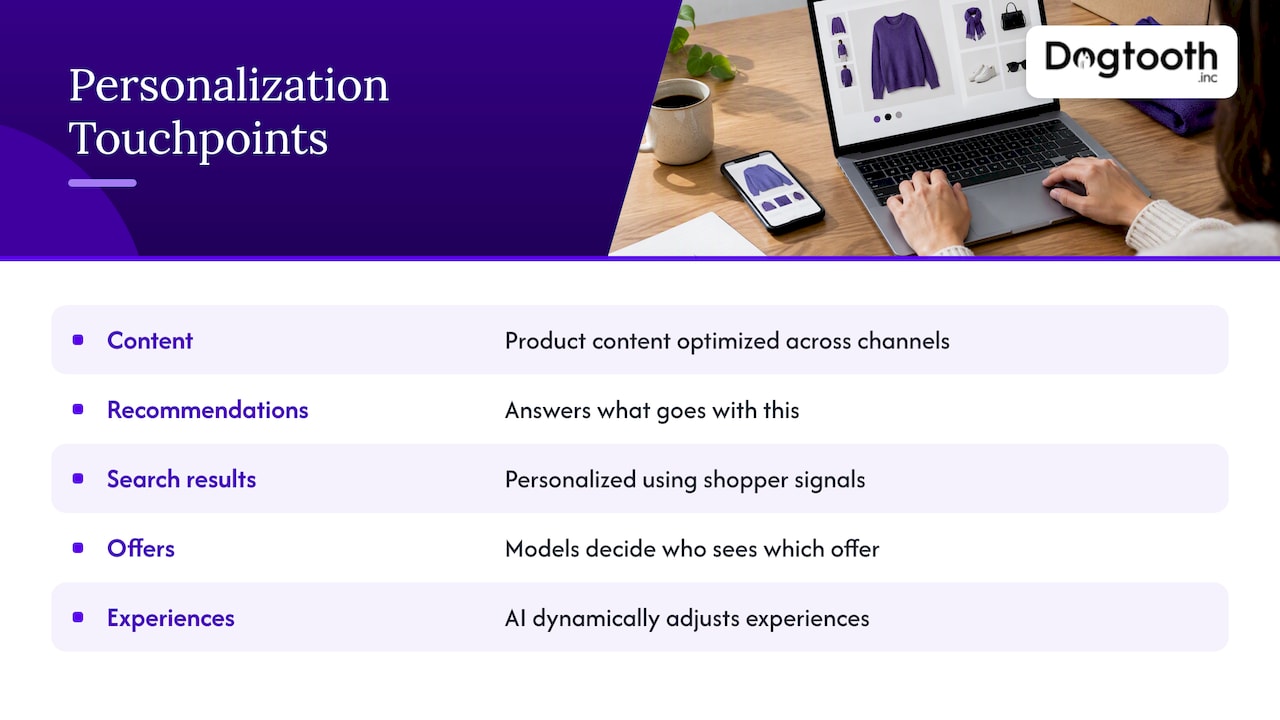
Recommendations answer “what goes with this?” Merchandising answers “what should this shopper see first?” SAP’s resources describe AI that can dynamically adjust content, recommendations, search results, offers and experiences, and optimize product content, pricing and assortment across channels.
Three areas deserve attention:
Category pages. Adobe Commerce’s AI merchandising can automatically re-rank category products using algorithms such as Recommended for You, Most Viewed, Most Purchased, Most Added to Cart and Trending, while still allowing manual pinning, boosting, burying or hiding. That last part matters. The best setups keep a human override for launches, margin priorities and brand rules.
Search. Personalized search blends textual relevance with shopper signals. Adobe’s example: a shopper with prior Samsung purchases can see Samsung phones ranked above other brands for a generic phone query. Google Cloud documents the same idea with personalized text-search and browse results based on views, clicks, add-to-cart events and purchases, plus query expansion, facets, boosting, burying and revenue-oriented browse ordering.
Promotions and assortment. Models can decide who sees which offer, and which products deserve space. This is where the business rules get tricky: you do not want the model discounting to shoppers who would have bought at full price, or surfacing items you are trying to clear for the wrong reasons. Encode margin floors and exclusions as constraints, not as afterthoughts.
SAP also points to a shift beyond suggestions toward active task execution, such as autonomous pricing and assortment optimization. That is where the category is heading. For most stores, though, the sound order is: get recommendations and search working and measured first, then widen the model’s authority.
What results to expect, and how much to trust the numbers
Vendor pages are full of dramatic lift figures. Treat them as marketing. The more useful evidence comes from randomized experiments. An FTC-hosted paper on privacy and personalization reports Wayfair field experiments in which personalization improved consumer-product matches, raised seller and platform revenue, lowered returns by 10% and raised repeat-purchase probability by 2.3%.
Two takeaways. First, the gains show up in several places: revenue, returns and repeat purchase, not just conversion. Second, this is one large marketplace with a deep catalog and heavy traffic. A store with 200 products and modest volume will see a different effect, and some pages will show nothing. The only number you can plan around is the one you measure on your own store against a control group.
The same paper estimates that browser privacy restrictions fragment data, and a Wayfair-based study put the cost at 30% of consumer welfare and 8.6% of smaller sellers’ revenue. The point for operators: the quality of the data you can legitimately collect directly affects what personalization can do.
Implementing AI recommendations and merchandising
There are two broad paths: switch on a managed capability inside your platform or search provider, or build a custom layer that uses your own data and logic. Brands with established volume often end up with a hybrid: a managed model for ranking, and custom code for the rules, integrations and data plumbing around it. Whichever you choose, the work runs in the same order.
- Audit the event data. Views, clicks, add-to-cart and purchase events must fire reliably and carry product identifiers that match your catalog. If purchase events only fire in the browser, you will lose some to blockers and failed redirects. Our guide to server-side tracking for payment events covers how to capture them reliably.
- Clean the catalog. Titles, categories, attributes, availability and images feed the candidate and filtering stages. A model cannot recommend well from a messy catalog.
- Unify identity. Shoppers move across sessions and devices. Algolia lists cross-session and cross-device identity consistency among the requirements for modern personalization, along with privacy, real-time operation and transparency.
- Start with one placement. Pick the page with the most traffic and a clear goal, often the product page or cart, and launch there.
- Add business rules. Margin floors, exclusions, pinned products, inventory thresholds. Make sure merchandisers can override the model.
- Connect the channels. Once one placement works, extend to search, category pages and email so a shopper’s experience stays consistent.
- Instrument everything. Log what was shown, in what order, and what happened, so you can test. More on that below.
If your store is on Shopify, personalization lives alongside the rest of your conversion work. Our posts on Shopify conversion rate fixes and checkout optimization show the surrounding levers, and AI customer experience looks at how AI fits into the broader journey.
Measuring and improving personalization
Personalization that is not measured is a cost center with a good story. Google Cloud’s guidance recommends A/B testing with control groups and unique experiment IDs in event logs, so you can compare AI-powered cohorts against controls for search and recommendations separately.
The metrics it points to are revenue per visit, conversion rate and average order value. Of the three, revenue per visit is the most honest headline number, because a model can raise conversion by pushing cheap items while lowering order value, and revenue per visit catches that trade-off. The same guidance recommends iterative tuning and monitoring data inputs for anomalies.
A workable testing routine:
- Keep a persistent holdout (for example, a small share of traffic that never sees personalized results) so you can see long-run lift, not just launch novelty.
- Change one thing per test: the placement, the algorithm or the rule set.
- Run tests long enough to cover a full weekly cycle and, if you can, a promotion period.
- Watch returns and repeat purchase as well as first-order revenue, since those are where the Wayfair experiments found part of the benefit.
- Alert on input anomalies. A broken tracking tag can quietly poison a model for weeks.
For teams building the reporting side, a privacy-aware custom attribution model helps separate what personalization contributed from what other channels did. For a wider view of how to judge AI-powered shopping experiences, this look at AI product videos and test drafts touches on the same discipline of testing before you commit.
Privacy, bias and operational risks in the U.S.
There is no single federal privacy law for ecommerce personalization, but the FTC is active. A 2025 FTC summary of its AI work says the agency has required companies to substantiate claims about AI safety, bias and efficacy and has taken enforcement action over unlawful collection or misuse of consumer data for AI training. In practice: do not advertise your personalization as “unbiased” or “proven to lift sales” unless you can document it, and do not repurpose customer data for model training beyond what you told shoppers.
Data minimization is part of the conversation too. FTC Commissioner Melissa Holyoak argued in a 2024 speech that the principle needs a nuanced view that weighs the benefits of large datasets against implementation costs. The workable reading for a store: collect what the use case needs, say why, and delete what you no longer need.
If you sell to California residents, consent and opt-out handling needs real attention. This walkthrough of Shopify CCPA compliance admin steps shows how the Customer Privacy API fits in. Have counsel confirm what applies to your business and states.
Operational risks are less discussed and just as real:
- Filter bubbles. If the model only shows what a shopper already likes, discovery and average order value can stall. Reserve slots for exploration.
- Stock and margin blind spots. A recommended product that is out of stock, or a discount to a full-price buyer, is a model doing its job against your interests.
- Silent drift. Seasonality, new catalog and tracking changes shift inputs. Review model output on a schedule.
- Risk is context-dependent. Regulators and standards bodies treat low-stakes recommendation systems differently from high-stakes ones. The Consumer Technology Association told NIST that media recommendation systems likely present very low risk compared with industrial or medical AI. Product suggestions sit toward the low end, but pricing and eligibility decisions can carry more weight.
Our perspective: personalization is a workflow problem
Most personalization projects we see stall for plumbing reasons, not model reasons. The recommendation widget is the easy part. The hard part is that purchase events live in three systems, the catalog has inconsistent attributes, and nobody owns the question of whether the thing is working.
We build AI into real workflows: drafting, checking, booking and reporting. One of our agents books sessions, charges cards and sends invites for three brands at once, and the lesson from that combat sports booking build applies here. AI earns its place when it sits inside the operation, with clear inputs, checks and a human who can approve or override.
We run our own marketing the same way. An in-house AI campaign manager drafts on-brand emails, runs compliance checks, tests inbox delivery and schedules sends on a single approval. So our advice is shaped by running it, not just recommending it: start with one placement, instrument it properly, keep merchandisers in control, and expand only when a holdout shows lift. A senior team that stays on after launch matters, because models and catalogs need tuning long after go-live.
— Chase Weir
Build it with Dogtooth
If your store has real volume and your data, platform or tracking is holding personalization back, that is the work we do. Our e-commerce engineering covers Shopify and WooCommerce builds and optimizations, integrations and APIs, custom attribution, and AI agents that work inside your existing workflows. Our Shopify and WooCommerce dual-platform store and craft brewery POS and Shopify integration show how we approach connected commerce systems.

To talk through your store, start at dogtoothinc.com.
FAQ
What is the difference between AI product recommendations and AI merchandising?
Recommendations suggest items related to what a shopper is viewing, carting or has bought, usually in carousels, carts and emails. Merchandising controls the order and visibility of products across category pages, search and promotions. Both use the same behavioral signals, and merchandising typically adds manual controls such as pinning and burying.
How much data do I need before AI personalization works?
There is no universal threshold, but finer-grained personalization needs more data to learn complex patterns, as the academic review notes. Smaller stores can start with popularity-based and context-based recommendations, then add individual-level models as event volume and catalog quality grow. Check your tracking first, because missing or duplicated events hurt more than low volume does.
How do I know if personalization is actually working?
Run an A/B test with a control group and log a unique experiment ID on every event. Compare revenue per visit, conversion rate and average order value between the groups, and keep a long-running holdout to confirm the lift persists. Also check returns and repeat purchase, since a lift in first orders can hide worse outcomes later.
Does the FTC regulate ecommerce personalization?
The FTC has required companies to substantiate AI claims about safety, bias and efficacy, and has acted against unlawful collection or misuse of consumer data for AI training. That makes your marketing claims and data practices the main exposure. Ask a privacy attorney how federal and state rules, such as California’s, apply to your business.
Sources
- AI and Personalization, academic review
- AI Personalization in Ecommerce, Shopify
- Setting your AI strategy to power ecommerce personalization, Adobe
- Mastering Personalization with AI, Algolia
- What is Hyper-personalization, IBM
- Features and capabilities of AI Commerce Search, Google Cloud
- Ecommerce product recommendations: a practical build guide
- Recommendation algorithms, Adobe Target documentation
- Elevate customer experience with AI personalization, PayPal
- Why E-commerce Personalization Is No Longer Enough, SAP
- Personalize ecommerce merchandising with AI in Adobe Commerce
- Balancing User Privacy and Personalization, FTC
- General guidance on conducting A/B experiments, Google Cloud
- Additional considerations and testing, Google Cloud
- AI Product Videos for Online Sellers: Test Drafts
- The FTC is on the Front Lines of AI Innovation and Regulation
- Remarks of Commissioner Melissa Holyoak, 2024
- Shopify CCPA Compliance: 4 Admin Steps
- AI RMF RFI Comments, Consumer Technology Association