Custom platform development means building software around how your business actually runs, instead of bending your operation around a product sold to everyone. It pays off when the workflow, data or customer experience is what sets you apart, and when your current tools force workarounds. The best results come from a senior team that ships in small weekly releases and stays on after launch. That is how we work at Dogtooth Inc, and it is the model this guide uses.
TL;DR
- Custom platform development is software written for one organization’s needs, as opposed to a product sold in the same form to every buyer.
- Build custom where you differentiate (rules, experience, data). Buy or rent the commodity parts such as payments, identity and messaging.
- A scalable platform is a core with clean APIs, modular services, security and observability built in, not bolted on later.
- Cost and timeline depend on scope, integrations, data migration and how much of the work is genuinely new. Ask for a phased plan, not one big estimate.
- Plan for the life after launch. The platform needs owners, monitoring and a steady release rhythm.
Table of Contents
- What custom platform development actually is
- When custom beats adapting an existing product
- What scalable platform architecture looks like
- What a custom platform project includes
- What drives cost and timeline
- Custom platforms for e-commerce, migration and AI
- How we build platforms at Dogtooth
- Our perspective
- FAQ
- Sources
What custom platform development actually is
The U.S. government’s technology team, 18F, defines custom software as code written specifically for a buyer’s needs, built by an in-house team or a vendor and put into production with the buyer’s IT department. Commercial off-the-shelf software (COTS) is the opposite: sold in the same form to any customer and adjusted only through the settings it ships with.
A “platform” differs from a single app in one way that matters. An app solves one job. A platform is a foundation that several jobs run on: customer accounts, orders, bookings, payouts, reporting, automation. New features reuse the same data and services instead of starting from scratch.
In practice, a custom platform might be:
- A customer or practitioner portal with logins, dashboards and payment splits.
- An e-commerce back end that connects storefronts, inventory, fulfillment and attribution.
- An internal operations dashboard that pulls live data from several systems.
- An AI layer that drafts, checks, books and reports inside your real workflows.
If you also see this called a custom software platform or enterprise platform development, it is the same idea at different scales: more users, more systems to connect, stricter security and governance.
When custom beats adapting an existing product
Not every need justifies a build. The useful test is to sort what your business does into three buckets:
- Commodity: identity, messaging, payments, hosting. Use managed services.
- Configurable: CRM, help desk, standard storefront. Configure a proven product.
- Differentiating: pricing rules, the booking or onboarding experience, proprietary data, the way your team makes decisions. This is where custom code earns its keep.
Signs you are in the third bucket:
- Your team keeps exporting spreadsheets to bridge two systems.
- A vendor’s roadmap decides what you can offer customers.
- You have paid for so many customizations that the product no longer resembles what you bought. 18F calls this unrecognizably modified off-the-shelf software: you pay license fees and custom development at the same time.
- Low-code tools got you 80% of the way, and the last 20% keeps stalling. The same 18F guide notes that low-code and no-code platforms often still need custom development and can be harder, costlier and riskier than expected.
- Your volume has grown past what the plan tier or the data model supports.
A worked example: a brand sells through a Shopify storefront and a WooCommerce store, with separate customer records and inconsistent reporting. Replacing both with one monolith is rarely the answer. Often the better move is a custom integration layer that keeps each storefront where it performs and unifies orders, customers and attribution behind it. We built exactly that kind of setup in our Shopify and WooCommerce dual-platform store project.
What scalable platform architecture looks like
Scalability is less about picking a fashionable stack and more about a handful of decisions made early.
A well-defined core and clean APIs
Every platform needs a core that owns your key records (customers, orders, sessions, subscriptions) and exposes them through documented APIs. Other systems connect to that core instead of to each other. When you swap a payment provider or add a new storefront, you change one connection, not twelve.
Modular services
Split the platform by business capability: billing, scheduling, notifications, reporting. Each can be scaled, tested and released on its own. You do not need dozens of microservices on day one. A well-organized modular application that can be split later is a sound starting point for most mid-sized organizations.
Configuration before code
Rules that change often, such as pricing tiers, email templates, routing and approval thresholds, should live in configuration your team can edit, not in code that needs a deployment. This keeps the platform responsive to the business without a developer ticket for each tweak.
Security, observability and governance from the first sprint
Access control, audit trails, logging and alerting are far cheaper to design in than to retrofit. For anything touching cards or personal data, build these into the foundation and keep payment handling with a specialized payments provider.
Planning for AI workloads
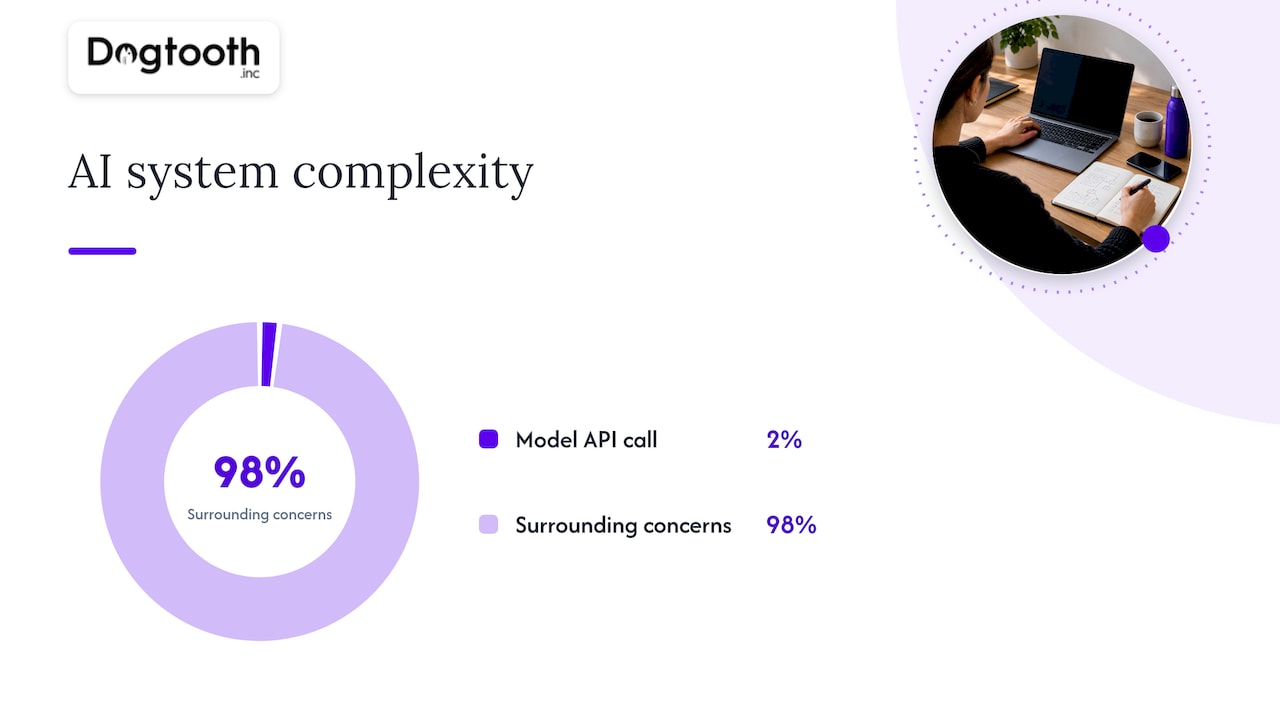
If AI agents will run on your platform, the architecture has to carry more than the model call. Manning’s Designing AI Systems puts the model API call at about 2% of total system complexity, with the other 98% made up of knowledge management, session management, safety and compliance, tool integration, observability, model management and infrastructure. AWS’s guidance on enterprise-ready generative AI platforms describes four layers: dependable data and compute, approved models and tools, security and governance, and repeatable patterns such as retrieval-augmented generation and agentic workflows. For a closer look at the a platform should provide, start there, then map each layer to your own systems.
One caution on timing: O’Reilly argues that the protocol layer for agents is still being invented, with the Model Context Protocol emerging as the tool-integration standard and agent-to-agent protocols still shifting. The practical lesson is to keep agent logic behind your own interfaces so you can adopt standards as they settle. We cover the runtime side in our guide to AI agent safety controls and the review side in human-in-the-loop oversight models.
What a custom platform project includes
A well-run project moves through the same stages whatever the size. What changes is how long each takes.
1. Discovery
The team maps the current workflow, the systems involved, the data and the people who use them. The output is a prioritized list of problems and a decision on what is custom, what is configured and what is bought. Skipping this step is the most common reason builds drift.
2. Architecture and design
This covers the data model, the integration map, the security approach and the user experience for each role (customer, staff, admin). Decisions here are cheap to change. After launch they are not.
3. Incremental build
Build in thin slices that reach real users early. Weekly releases let you see working software, correct course and retire risk while the budget is still flexible. This is how we ship at Dogtooth.
4. Migration and integration
Moving data and connecting systems is usually where timelines slip, because old data is messier than anyone expects. For legacy systems, replacing everything in one cutover is risky. A gradual approach, routing traffic to new services piece by piece, keeps the business running. Our write-up on API modernization without a big bang explains the pattern, and our Drupal 6 research platform migration shows it applied to an aging platform moved to a modern stack.
5. Launch and ongoing support
Launch is the start of the platform’s working life. Plan for monitoring, security updates, performance tuning and a backlog of improvements. Our team stays on after launch to support scaling and efficiency, so the people who built the platform are the ones who keep it healthy.
What drives cost and timeline
No honest vendor can quote a serious platform from a one-line description, and published price ranges vary widely because the factors below vary widely. These move the estimate most:
- Scope and number of user roles. Each role adds screens, permissions and testing.
- Integrations. Every external system (payments, CRM, ERP, shipping, email) adds build and test effort, and each one’s quality changes how smooth it is.
- Data migration. Volume, age and cleanliness of legacy data often matter more than the new features.
- Compliance and security. Handling payments, health or personal data raises the bar for design and review.
- AI components. Agents need guardrails, evaluation and monitoring in addition to the model call.
- Team seniority and continuity. Experienced engineers make fewer structural mistakes, and a team that stays through launch avoids relearning your business.
The practical way to control cost is to phase the work. Start with the one workflow that hurts most, release it, measure it, then expand. Define success numbers before building: hours saved per week, order errors removed, time to onboard a customer, cost per transaction. Those measures also tell you later whether the custom decision was right, and where to invest next.
Custom platforms for e-commerce, migration and AI
E-commerce. Storefront platforms such as Shopify and WooCommerce handle the commodity parts well. Custom work goes into what sits around them: integrations with inventory and fulfillment, custom attribution so you know which channels produce revenue, practitioner or wholesale portals, and email infrastructure that keeps messages reaching the inbox. Our e-commerce engineering work covers these layers, and our note on AI agents for e-commerce shows where automation helps most.
Legacy migration. The aim is to move to a platform your team can change quickly, without losing data or interrupting revenue. Inventory what the old system really does, including undocumented jobs, before choosing the target.
AI workflows. The strongest first projects are narrow and measurable: drafting, checking, booking, reporting. Our AI workflow automation guide explains how to start, and our combat sports booking case study shows an agent that books sessions, charges cards and sends invites for three brands at once.
How we build platforms at Dogtooth
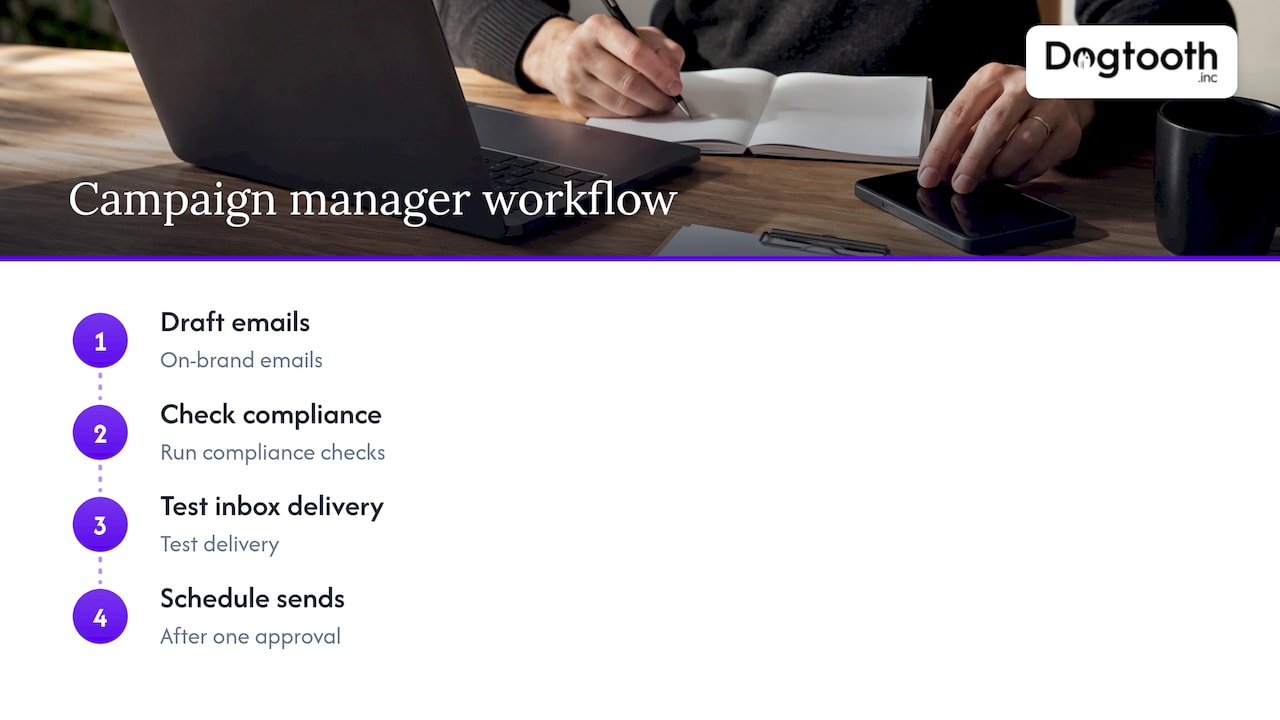
We are an AI-forward technical agency building custom platforms, legacy migrations, e-commerce systems and AI agents for brands doing real volume. A senior team treats each project as its own, ships weekly and stays on after launch. We also run our own operation the same way: an in-house AI campaign manager drafts on-brand emails, runs compliance checks, tests inbox delivery and schedules sends on a single approval. Our email deliverability software, MailFurnace, comes from that same work.
If you are weighing a platform build, a migration or an AI workflow, tell us the workflow that costs you the most time and we will scope from there. Start at Dogtooth Inc.
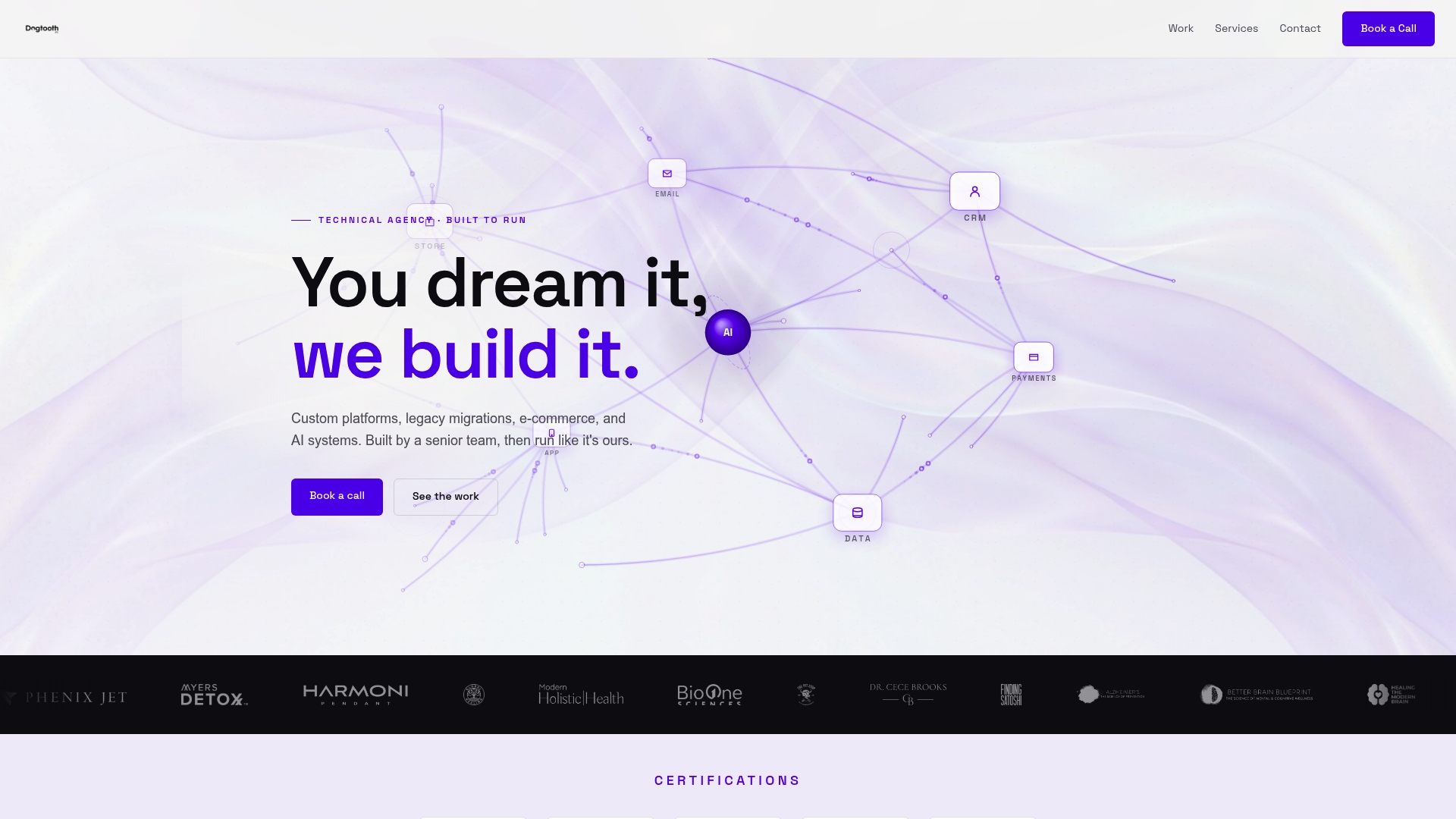
The services behind it include platform builds and migrations, custom web apps, e-commerce engineering, AI agents and automation, email infrastructure and deliverability, and integrations and APIs.
Our perspective
Most platform projects fail on scope, not on code. Teams try to build everything the old system did, plus everything they wished it did, and the first release arrives a year late.
We start from the opposite direction. Pick the workflow where the business loses the most time or money, build it end to end, put it in front of real users and release again the following week. Senior engineers do this best because they know which decisions are expensive to reverse and which are not.
We also think AI belongs inside the platform, not beside it. An agent that drafts, checks, books or reports is only as good as the data, permissions and approval steps around it. We run our own campaign operations on that principle: the system does the preparation and checks, and a person approves once.
The build is the beginning. The platform earns its value in the months after launch, which is why we stay on and keep improving it with you.
Chase Weir
FAQ
What is the difference between a platform and custom software?
Custom software is any code written for one organization’s needs. A platform is a custom foundation that multiple applications and workflows share, with common data, services and APIs. Building a platform makes later features faster because they reuse what already exists.
Is enterprise platform development different from a regular software project?
The method is the same, but the constraints are heavier: more integrations, more user roles, stricter security and audit requirements, and more stakeholders. That is why phased delivery and clear ownership matter more as the organization grows.
How do I know if I should migrate off a legacy system?
Look for rising maintenance cost, workarounds between systems, trouble finding people who know the technology, and an inability to add features customers ask for. If two or more apply, an inventory of what the system does and a staged migration plan is the right next step.
Can a platform be built in stages?
Yes, and it usually should be. Start with the highest-value workflow, release it, measure the result and expand. Staged delivery limits risk and shows progress in working software rather than status reports.
Sources
- Understanding and choosing a software solution, 18F
- Chapter 1: Why your AI projects need a platform, Designing AI Systems, Manning
- AWS Prescriptive Guidance: Building an enterprise-ready generative AI platform
- The Case Against Building Your Own Agent Platform, O’Reilly