Customer lifetime value (CLV) modeling estimates what each customer will be worth to your business over the rest of the relationship, so you can decide how much to spend to acquire, keep or win them back. The right model depends on how much clean data you have: a margin-based formula with cohorts works for most young businesses, and probabilistic or machine-learning models pay off once purchase histories are long and customer identities are reliable. In practice, the model is the easy part. Joining orders, subscriptions, email engagement and ad spend into one trustworthy customer record is where most projects stall, and it is the work we do at Dogtooth.
TL;DR
- CLV is a forecast of future contribution, not a total of past revenue. Use gross margin, not revenue, whenever you compare it with acquisition cost.
- Start with the formula and cohorts. Move to RFM, BG/NBD with Gamma-Gamma, or machine learning only when your data and decisions justify it.
- Predictive models need a persistent customer ID, dated transactions with amounts, and margin data, ideally with a year or more of history.
- Validate on a later time period than the one you trained on, and judge the model by whether decisions improve, not by one accuracy score.
- Most failures come from fragmented data, not from the math. Fix the data pipeline first.
Table of Contents
- What CLV modeling actually estimates
- Start with the formula
- Choosing a modeling approach
- The data a CLV model needs
- Validating a model before you spend on it
- Putting modeled CLV to work
- Where we come in
- Our perspective
- FAQ
- Sources
What CLV modeling actually estimates
A UCLA Anderson marketing research paper on modeling customer lifetime value defines CLV as the present value of all future profits from a customer over the life of the relationship, estimated for individual customers or segments so a business can treat them differently. Three words in that definition do the work.
Future. Revenue a customer has already paid you is history. It is useful for reporting and cohort analysis, but it tells you nothing certain about the next 12 months. A modeled CLV has to estimate how long the customer stays and what they will buy.
Profit. Revenue overstates value because it ignores the cost of fulfilling orders, processing payments, shipping and support. If you compare a revenue-based figure with your acquisition cost, you will approve spending you cannot afford.
Present value. A dollar three years from now is worth less than a dollar today, so long-horizon models discount future profit. For a business with short customer lifespans, this matters little. For a subscription or a replenishment brand with multi-year customers, it changes the answer noticeably.
Start with the formula
Every model, however sophisticated, is a refinement of one idea: how much a customer spends per purchase, how often, and for how long.
Twilio’s CLV guide gives the basic version as average purchase value times purchase frequency times customer lifespan. Its e-commerce example is $75 per purchase, 3 purchases a year, 4 years: a CLV of $900.
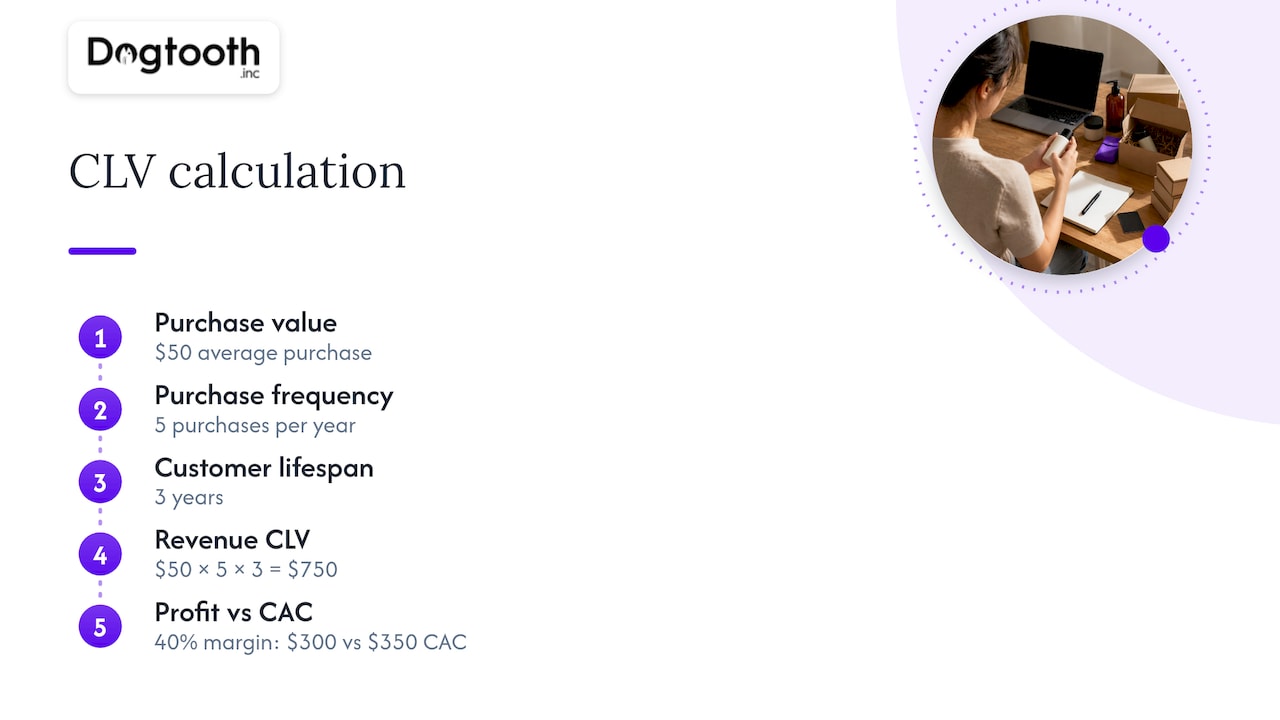
Mailchimp’s worked example shows where the inputs come from. An online clothing store with $500,000 in revenue across 10,000 orders has a $50 average purchase value. Those 10,000 orders came from 2,000 customers, so the average customer buys 5 times a year. With a three-year average lifespan, CLV is $50 × 5 × 3 = $750.
That figure is revenue. To turn it into something you can compare with acquisition cost, multiply by gross margin. At a 40% margin the same customer is worth $300 in gross profit over three years. A business can look healthy at $750 and be underwater at $300 once it pays $350 to acquire the customer.
Add margin and discounting
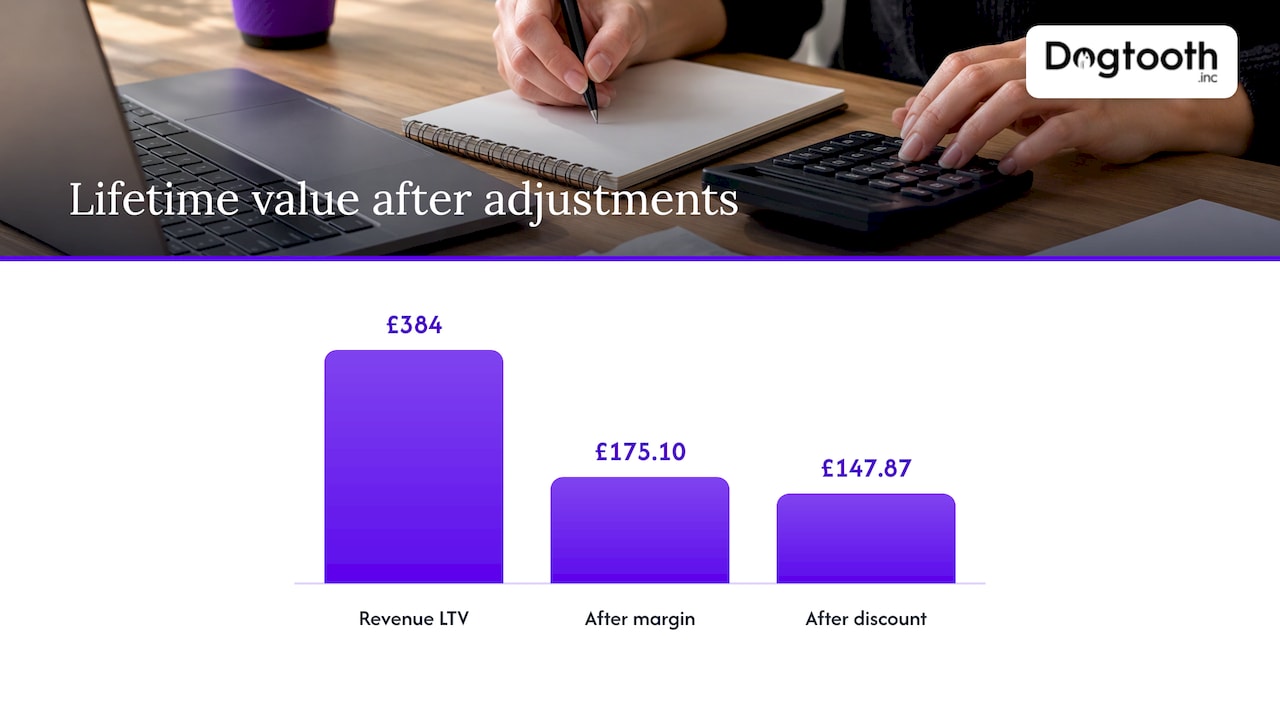
A worked example from Instilus shows how much the details matter. A candle maker with a £48 average order, 3.2 orders a year and 2.5 years of retention (a 40% annual churn rate gives 1 ÷ 0.40 = 2.5 years) has a revenue lifetime value of £384. After a 45.6% contribution margin, it falls to £175.10. Discounted at 10% a year, it falls again to £147.87. Against a £20 acquisition cost, the ratio of lifetime value to acquisition cost drops from 8.8:1 to 7.4:1. The business is still fine, but the decision margin you thought you had was thinner.
When you build your own version, write down each choice explicitly:
- Revenue or margin. Use contribution margin for acquisition decisions.
- Lifespan source. Take it from retention or churn data for the same customers whose spend you are measuring. Mixing a churn rate from one segment with spend from another produces numbers that look precise and mean nothing.
- Horizon. Cap the forecast at a period you can defend, such as 12, 24 or 36 months, rather than an open-ended lifetime.
- Discount rate. Set one and apply it consistently.
Choosing a modeling approach
The approaches below run from cheap and transparent to powerful and demanding.
| Approach | What it does | Best when | Main risk |
|---|---|---|---|
| Average formula | Spend × frequency × lifespan for the whole base | Early stage, quick sanity check | Hides big differences between customers |
| Cohort analysis | Tracks groups acquired in the same period and extends their curves | Under about 500 customers or short history | Assumes new cohorts behave like old ones |
| RFM scoring | Ranks customers by recency, frequency and monetary value | Segmenting and prioritizing outreach | Ranks customers but does not forecast dollars |
| BG/NBD + Gamma-Gamma | Forecasts future purchase counts and order values per customer | Repeat-purchase e-commerce with enough history | Needs clean transaction data and validation |
| Machine learning | Predicts value from many behavioral and account features | Large datasets, B2B and multi-product businesses | Opaque, easy to leak future information into |
Heuristics and cohorts first
Kayako’s guide offers a practical rule: with fewer than 500 customers or less than 24 months of behavioral data, use historic CLV with cohort segmentation. Move to a predictive model when you have enough data and a real need for acquisition targeting or retention prioritization. Historic CLV is auditable and available immediately, which counts for a lot when finance has to sign off on the number.
Probabilistic models for repeat purchasing
For non-subscription retail, the problem is that customers never announce they have left. They just stop buying. Omniconvert’s predictive CLV guide describes the standard e-commerce pairing: a BG/NBD model estimates how many purchases a customer will still make, accounting for silent churn, and a Gamma-Gamma model estimates their average order value. Multiply expected transactions by expected profit per order, discount over a horizon such as 12 months, and you have a per-customer forecast.
This pairing is a sensible baseline because it needs only three fields per customer: when they bought, how often, and how much.
Machine learning, where it earns its place
Machine learning helps when value depends on many signals at once. A 2023 Journal of Marketing Analytics study proposed a hierarchical ensembled model for B2B software-as-a-service companies that predicts CLV across multiple products and, in the authors’ empirical results, beat simpler heuristics and traditional approaches. The predictions were used to optimize marketing spend and return on investment.
If you sell to businesses and are weighing how to attribute pipeline to the channels that produce high-value accounts, these lead attribution models for B2B are a useful companion to a CLV model, since predicted account value only helps if you can trace it back to the source.
Subscription and contract businesses have their own technique. A SAS paper on predicting customer value explains that for contractual customers, such as banking, insurance or telecom, remaining CLV is the sum of discounted cash flows over the residual life, with churn modeled through hazard models. For a company with several separate products, it notes that modeling churn by product avoids abrupt cash-flow drops when a customer cancels one product but keeps another. CLV is then the sum of product-level values.
The data a CLV model needs
Predictive models are only as good as the customer record under them. At minimum you need:
- A persistent customer identifier that links every transaction to the same person or account over time, across web, subscription billing, marketplace and offline channels.
- Dated transactions with amounts, including refunds and cancellations, so the model sees not just when customers bought but when they did not.
- Margin data, because CLV is a profit figure. Product cost, shipping, discounts and payment fees all belong in it.
- Behavioral and attribute data, such as acquisition channel, product category, email engagement and support contacts, for models that go beyond recency and frequency.
- History. Perspective AI’s guide suggests ideally 12 or more months of transaction history for RFM-style models. Growth-Onomics recommends at least one to two years and two to three transactions per customer, with two to three years ideal.
The most common blocker is not volume but identity. If the same buyer appears under two email addresses, or a subscription platform and a storefront each hold half the order history, every downstream number is wrong. Fixing this is engineering work: unifying records, building the integrations that keep them in sync, and exposing the result in a dashboard people actually open. Our cross-channel attribution guide covers the same data foundations from the marketing side, and our walk-through on building a privacy-aware custom attribution model shows how to keep that data usable under consent constraints.
Validating a model before you spend on it
A CLV model that has not been tested on data it has never seen is an opinion. Three habits separate a usable model from a decorative one.
Test forward in time. Train on one period, then score a later period and compare predictions with what customers actually did. Sekin’s guide recommends time-based training, validation and test windows, a holdout after the training cutoff, and metrics such as mean absolute error, rank correlation and top-decile lift. It also recommends checking calibration: customers predicted at $100 should generate about $100.
Avoid leakage. Never let the model see orders, refunds or churn status that occur after the scoring date. This is the most common reason a model looks brilliant in testing and fails in production.
Watch survivorship. Trusted Data AI warns that validating only on customers whose lifetime is already complete skews results, because the customers still active are the ones you are trying to forecast. It also recommends storing prediction intervals alongside the expected value, and when a bad outcome is hard to reverse, setting investment against a conservative percentile rather than the mean.
A practical sequence: build the simple baseline first, then adopt a more complex model only if it beats the baseline on held-out data.
Putting modeled CLV to work
A CLV number earns its keep when it changes a decision.
- Acquisition budgets. Mailchimp notes that CLV can set acquisition budgets, and Stripe’s guide makes the logic concrete: a cafe customer visiting 20 times a month at $6 for 60 months is worth $7,200, which justifies spending more to win that customer than a one-time visitor would.
- Segmentation. Rank customers by predicted value and treat the top decile differently from the long tail: faster support, early access, or a personal call for high-value accounts.
- Retention. Predicted value plus churn risk tells you whom to save. Trusted Data AI adds an important caution: keep CLV, churn risk and treatment uplift as separate questions. A customer with £600 of residual value is not worth a £40 retention offer if the offer lifts retention by only three percentage points.
- Forecasting. Aggregate customer-level forecasts into revenue projections by cohort or channel.
- Personalization and lifecycle messaging. Value predictions can steer which customers get which offers. See how we approach AI personalization for e-commerce.
One more place CLV pays off: win-back. If your email list has gone cold, the lapsed subscribers with the highest predicted value are where a re-engagement campaign should start, and deliverability work should protect those sends first.
Where we come in
Most companies reading this already have the raw material: an order system, a subscription platform, an email tool, an ad account. What they lack is the connective tissue. We build custom platforms, integrations and APIs, custom attribution systems and real-time operations dashboards, so customer, order and engagement data land in one place and stay current. For example, we rebuilt a subscription revenue recovery setup after a Drupal subscription failure, and we built a multi-product wellness brand ecosystem where several products and channels had to be read as one business.
Our AI agents work inside real workflows, drafting, checking, booking and reporting, and our email infrastructure and deliverability work, including our MailFurnace software for high-volume senders, keeps the messages that act on your CLV segments reaching the inbox. If you want a CLV model running on data you can trust, talk to the Dogtooth team.
Our perspective
We run our own operation on the same principle we build for clients: put AI in the loop, keep a senior person accountable, and measure what happens. Our in-house AI campaign manager drafts on-brand emails, runs compliance checks, tests inbox delivery and schedules sends on a single approval. That only works because the data underneath it is organized.
The same is true of CLV. Teams ask us which model to use, and the honest first answer is usually a simpler one than they expect, applied to a customer record that is finally correct. A cohort curve built on unified data beats a neural network built on three disconnected exports.
Our advice is to treat a CLV model as a product, not a report. Give it an owner, put it in the tools your marketing and operations teams already use, and let it feed real decisions: who gets the win-back sequence, which channel gets more budget, which accounts get a call. Then keep iterating. That is how we ship, weekly, and why we stay on after launch.
Chase Weir
FAQ
What is a good customer LTV?
There is no universal number, because it depends on your margins, acquisition cost and category. A good LTV is one that comfortably exceeds what you pay to acquire and serve the customer, measured in gross profit rather than revenue. Compare it with your own cost to acquire a customer and track how it moves by cohort over time.
How do I figure out customer lifetime value?
Multiply average purchase value by purchase frequency and by customer lifespan, then multiply by gross margin to get a profit figure. In the Mailchimp example, $50 × 5 purchases a year × 3 years gives $750 in revenue. Pull all three inputs from the same customer base and the same time period.
What is the difference between historical and predictive CLV?
Historical CLV adds up what customers have already generated, which is auditable but ignores what comes next. Predictive CLV forecasts future purchases and value using statistical or machine-learning models. Use historical figures for reporting and cohort payback, and predictive ones for budgeting and targeting once your data supports them.
How much data do I need to build a predictive CLV model?
Guidance varies by source, but a common starting point is 12 to 24 months of transaction history with several purchases per customer, plus a reliable customer ID. Kayako suggests cohort-based historic CLV when you have fewer than 500 customers or under 24 months of data.
How do I know if my CLV model is accurate?
Train it on an earlier period, then compare its predictions with what customers actually did in a later period. Check that predicted values match actual averages by customer group and that the model ranks high-value customers correctly. If a more complex model cannot beat a simple baseline on that test, keep the baseline.
Sources
- Modeling Customer Lifetime Value, UCLA Anderson
- Customer lifetime value: formula, calculation and examples, Twilio
- How to Calculate Customer Lifetime Value, Mailchimp
- Customer Lifetime Value: Formula and Worked Example, Instilus
- What Is Customer Lifetime Value and How to Calculate It, Kayako
- Predictive Customer Lifetime Value: Forecast CLV for DTC, Omniconvert
- A novel approach to predicting customer lifetime value in B2B SaaS, Journal of Marketing Analytics
- Predicting Customer Value, SAS
- Predictive Customer Lifetime Value: Models, Methods, and When They Mislead, Perspective AI
- Data Needed for Predictive CLV Models, Growth-Onomics
- How to Predict Customer Lifetime Value, Sekin
- Customer Lifetime Value Prediction, Trusted Data AI
- What is Customer Lifetime Value, Stripe
- Three Lead Attribution Models for B2B, Matched to Your Data