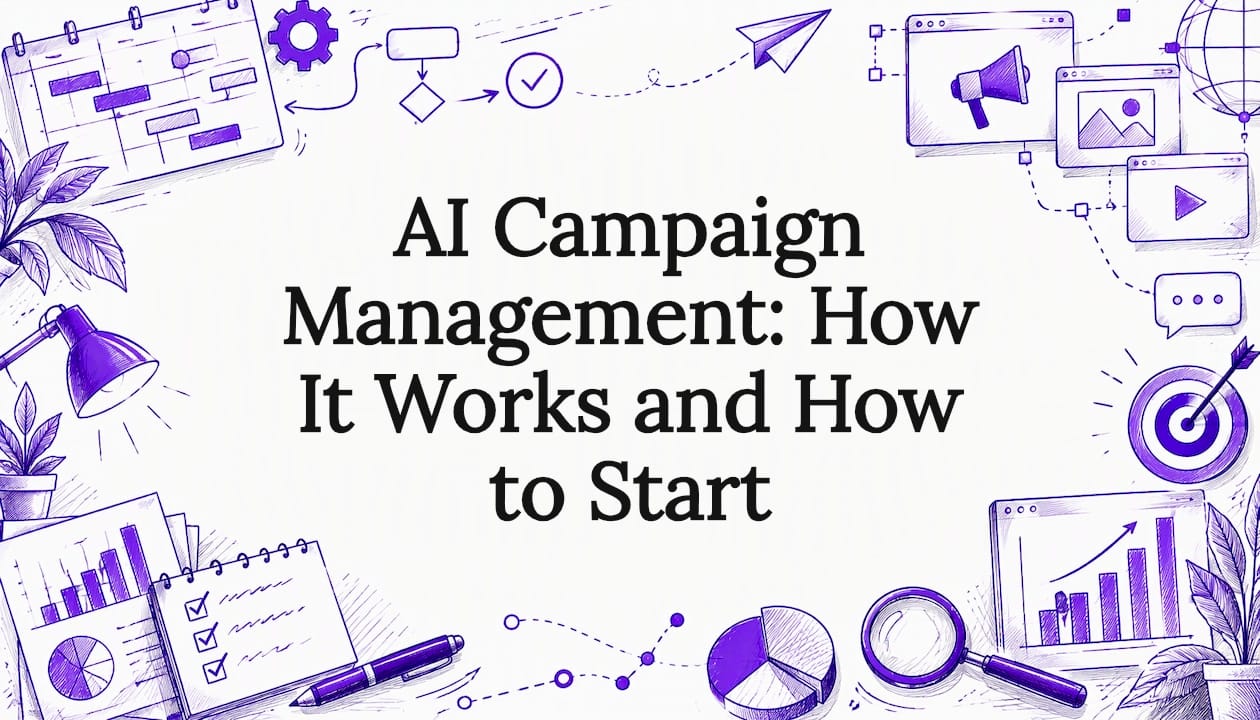
AI campaign management means using AI agents to handle the repeatable work across a campaign’s life: drafting, checking, scheduling, optimizing and reporting. You set the goal and the guardrails. The agent does the legwork and brings you decisions to approve. Teams that get value from it treat it as an operating layer on top of the systems they already run, not as a replacement for their marketers.
This guide covers what an AI campaign manager does, how it differs from the marketing automation you may already own, which tasks to hand over, how to roll it out, and how to measure whether it works.
TL;DR
- AI campaign management gives an agent a goal and live data, then lets it draft, check, schedule and report while a person approves what goes live.
- Marketing automation follows rules you wrote in advance. An AI agent decides how to investigate and respond within limits you set.
- Start narrow: one channel, one workflow, a human reviewer on every output, and a clear approval point before anything sends.
- Your data quality decides your results. Unified customer records and clean attribution come before the agent.
- Measure against a holdout group, not platform-reported numbers alone.
Table of Contents
- What AI campaign management actually is
- How it differs from marketing automation
- What to hand to the agent and what to keep
- A rollout plan you can run in three weeks
- Connect it to the systems you already have
- Check AI-generated content before it sends
- Measure whether it is working
- Where this goes wrong
- Our perspective
- Build it into your stack with us
- FAQ
- Sources
What AI campaign management actually is
The simplest definition: AI that works across the campaign lifecycle, from planning and launch through optimization and reporting. Guides describe a spectrum. At one end sit simple threshold rules. At the other sit autonomous agents that read a natural-language goal and make changes across several platforms.
Salesforce’s training material on agentic campaigns describes the shift well. Instead of configuring detailed channel logic yourself, you define high-level strategic intent and an AI engine handles the rest, with human approval checkpoints along the way. The agent works out the channel, content and timing for each customer.
An “AI campaign manager” is that agent, packaged as a working role. In practice it does four jobs:
- Drafts emails, ad copy and landing page variants in your brand’s voice.
- Checks its own work against brand rules, compliance requirements and deliverability tests.
- Schedules and launches sends or changes once a person approves.
- Reports on what happened and recommends what to try next.
The market is moving in this direction fast. Martech.org’s January 2026 analysis projects the US agentic AI market growing from $2.43 billion in 2025 to $65.25 billion by 2034. Projections like that are estimates, but they explain why so many marketing teams are being asked about it.
How it differs from marketing automation
Many readers searching this topic really want to know whether it is just marketing automation with a new label. It is not, though the two work well together.
Marketing automation executes instructions you define ahead of time. If someone abandons a cart, send email A after two hours. If they click, move them to segment B. The system is only as smart as the branches you built.
AI campaign management starts from a goal. Martech.org describes the difference this way: traditional automation executes tasks based on predefined instructions, while agentic AI sets agendas, adapts strategies and implements decisions within defined boundaries, learning continuously from new data.
| Rule-based automation | AI campaign management | |
|---|---|---|
| Starting point | Workflows you design | A goal and live data |
| Decisions | Predefined branches | Made in context, within limits |
| Content | Humans create it, the system delivers it | Agent drafts, human approves |
| Adaptation | You edit the rules | The agent reassesses as results arrive |
| Your role | Build and maintain logic | Set context, judge trade-offs, approve |
Neither one means “hands off.” Even in an agentic setup, the sensible default is that the agent recommends and a person decides what reaches the live account. Your job shifts from pulling numbers toward setting context and judging trade-offs.
What to hand to the agent and what to keep
The question that matters is not “can AI do this?” but “who signs off?” A workable split looks like this.
Let the agent run, with reporting:
- Pulling performance numbers and assembling reports
- Drafting first versions of emails, subject lines and ad variants
- Running pre-send checks: brand voice, required legal language, link validation
- Testing inbox placement before a send
- Scheduling approved sends
Keep a person in the approval seat:
- Anything that goes live to real customers for the first time
- Budget moves of any real size
- Messages touching regulated claims, disclosures or personal data
- Choosing what the campaign optimizes toward
- Creative and offer strategy
Martech.org’s advice for marketing leaders matches this: define roles clearly, leave repetitive tasks to agents and high-judgment work to humans, and build AI literacy on the team. That last point is easy to skip. A reviewer who rubber-stamps agent output is not a control. A reviewer who reads the reasoning is.
The decisions that stay yours as agents take over more investigation and execution are worth thinking through early. This look at AI’s productivity results for agencies is a useful lens on how much operational work can shift while strategy stays with people.
For the mechanics of keeping people in control, see our piece on human-in-the-loop oversight models and our guide to runtime controls for AI agents.
A rollout plan you can run in three weeks
The CMA’s AI Playbook on agent integration lays out a three-week sequence that is a good model for a first pilot, adapted here.
Week 1: connect the brief. Link the agent to your content brief process. Pick the human reviewers who will check its output. Decide now who has authority to approve what.
Week 2: load the brand and generate. Upload brand guidelines. Have the agent produce multi-format creative, and have a creative director review every piece. Note what the reviewer changes. Those edits are your best training signal for tightening the guidelines.

Week 3: connect the channels. Give the agent access to your ad platform APIs, with performance thresholds and permission to reallocate only within parameters you approved in advance.
A few practical rules for the pilot:
- Pick one channel and one campaign type. Email is a strong first choice because the loop from draft to result is short.
- Write down the stop conditions before launch. What triggers a pause? Who gets alerted?
- Keep a log of every agent action and every human override. You will need it for measurement and for audits.
The CMA playbook also stresses that team skills and change management often decide success more than which technology you choose. Budget time to train the people, not only to configure the tool.
Connect it to the systems you already have
An AI campaign manager is only as useful as what it can see and touch. It needs read access to your CRM, email service provider, ad accounts and analytics. It needs write access, carefully scoped, to actually schedule or adjust. And it needs a feedback loop that reads outcomes such as opens, clicks and purchases, so it can change what it tries next.
Three things tend to decide whether this works:
- A single customer record. An agent that can reach every tool but cannot tell that three records are the same person will make poor decisions. Resolve identities first, starting with the workflow that touches the most systems.
- Fresh data. Match data freshness to the task. A daily report can tolerate yesterday’s data. A send-time decision cannot.
- Rules stored as structured data. Keep your attribution model, channel taxonomy and naming conventions in a defined configuration rather than in someone’s head or a prompt. The agent then applies the same logic every time.
Before you let an agent write to production data, validate it. Spot-check a sample of records by hand, compare the agent’s totals against platform totals, and ask it to explain its calculations.
This is the unglamorous part, and it is where most projects stall. If your pipeline is patchy, our guide to the marketing data pipeline covers the stages and how to build them. If you are weighing where agents fit beyond campaigns, AI workflow automation is the broader starting point.
Check AI-generated content before it sends
Agents rarely fail dramatically. They drift. A tone slips, a claim gets a little stronger, a variant strays from approved messaging. Build checks that catch this.
- Accuracy: every factual claim, price and offer term is verified against a source of truth, not against the agent’s memory.
- Brand fit: tone and terminology are tested against your written guidelines.
- Privacy: actions involving personal data go to a human for approval.
- Compliance: required disclosures and opt-out language are present and correct for your market. For US email, have counsel confirm your requirements, since rules vary by channel and sector.
- Deliverability: test inbox placement before sending, not after complaints arrive.
Set a governance framework up front covering who decides what, how budgets get approved, how performance is judged and which brand and ethical guidelines apply. The CMA playbook recommends exactly this to keep AI-generated content accurate, appropriate, on-brand and unbiased.
Measure whether it is working
Track two kinds of numbers.
Outcome metrics show business impact: conversion rate, cost per acquisition, qualified pipeline created, revenue influenced and retention.
Operational metrics show whether the agent itself is behaving: task completion rate, how often reviewers override its suggestions, how often fallbacks trigger, and policy violation counts.
A rising override rate is a useful warning. It means the agent’s drafts are missing something your guidelines should capture.
The harder question is whether AI caused the improvement. Two habits help:
- Record a baseline. Document your key metrics over a 60 to 90 day window before you start.
- Hold out a control. Keep a segment, often around 10%, that never sees AI-driven changes. Without it, every ROI claim assumes nothing else changed.
With a holdout in place, incremental ROI is the treatment group’s revenue minus the control’s, scaled to the full audience, divided by what you spent on the AI for the period. Let that number drive budget decisions rather than platform-reported ROAS alone. (These measurement practices come from vendor guidance rather than a standards body, so adapt the percentages to your audience size.)
Where this goes wrong
Most failures come down to the same few causes:
- Too much scope at once. Teams connect five channels in week one and cannot tell what broke.
- No owner. Nobody is accountable for the agent’s output, so nobody reads it.
- Dirty data. The agent confidently optimizes against bad attribution.
- Approval theater. Reviewers click through without reading.
- No baseline. Six months later nobody can say whether it helped.
Each has the same fix: a narrow pilot, a named owner, clean inputs, reviewers who read reasoning, and numbers recorded before you begin.
Our perspective
We run our own marketing this way, so we are not guessing about how it feels in practice. Our in-house AI campaign manager drafts on-brand emails, runs compliance checks, tests inbox delivery and schedules the send. A person approves once, and that single approval is the control point. Everything before it is work the agent does so the person can spend their time judging, not assembling.
That design shapes what we build for clients. The agent should sit inside the real workflow, with access to the real systems, not in a side tool someone has to copy and paste from. We have built agents that book sessions, charge cards and send invites for three brands at once, and the lesson carries straight over to campaigns: the value is in the connections and the guardrails, not the model.
Our advice is to make the approval step explicit and the data underneath it trustworthy. Get the pipeline, the attribution and the deliverability right, and the agent has something solid to work from. A senior team that stays on after launch matters here, because the first version is never the last. You tune it against what your reviewers change and what your holdout shows.
Chase Weir
Build it into your stack with us
If you want an AI campaign manager that works inside your actual systems, that is what we build. Dogtooth Inc. designs and integrates AI agents for drafting, checking, booking and reporting, and builds the attribution and email deliverability infrastructure underneath them. For high-volume senders, our MailFurnace platform is built around deliverability. We ship weekly and stay on after launch.
See our services and how to start a project. To see an agent working in a live operation, read the combat sports AI booking case study.
FAQ
What does an AI campaign manager do?
It takes a campaign goal and works through the repeatable tasks: drafting content, running brand and compliance checks, scheduling sends, monitoring results and reporting. A person approves what goes live. The agent saves time on assembly so your team can focus on strategy and judgment.
Is AI campaign management the same as AI marketing automation?
No. Marketing automation runs rules you defined in advance. AI campaign management starts from a goal and lets the agent decide how to investigate and respond within limits you set. Many teams use both, with the agent working on top of existing automation tools.
Does AI replace the marketing team?
No. The practical model keeps people in charge of objectives, creative and offer strategy, measurement and every approval. Agents take over repetitive work. Your team’s role moves toward setting context and reviewing reasoning, which takes real skill.
How long does a first pilot take?
A focused pilot can run in about three weeks: connect the brief process, load brand guidelines and generate creative with human review, then connect one channel with thresholds. Plan extra time if your customer data is split across systems, since unifying records often takes longer than configuring the agent.
How do I prove it is working?
Record your key metrics for 60 to 90 days beforehand, then keep a holdout segment that never sees AI-driven changes. Compare results between the two groups and divide the incremental revenue by your AI spend for the period.
Sources
- Agentic Campaigns: AI-Driven Continuous Optimization (Salesforce Trailhead)
- Why agentic AI is different from traditional marketing automation (Martech.org)
- CMA AI Playbook: AI Agent Integration 101